

Modern intranet vs traditional document archive in public organisations

A social and health services director, an administrative secretary, or an operations manager knows the scene well. A colleague is faced with an urgent task, searches for a current guideline, and ends up in an archive or a shared drive where file names vary, versions are unclear, and the relevant file is located somewhere nobody can quite explain. The problem is rarely the employee; it is the purpose of the system, which does not fit the daily task.
When the employee looks for a guideline and finds a dusty archive
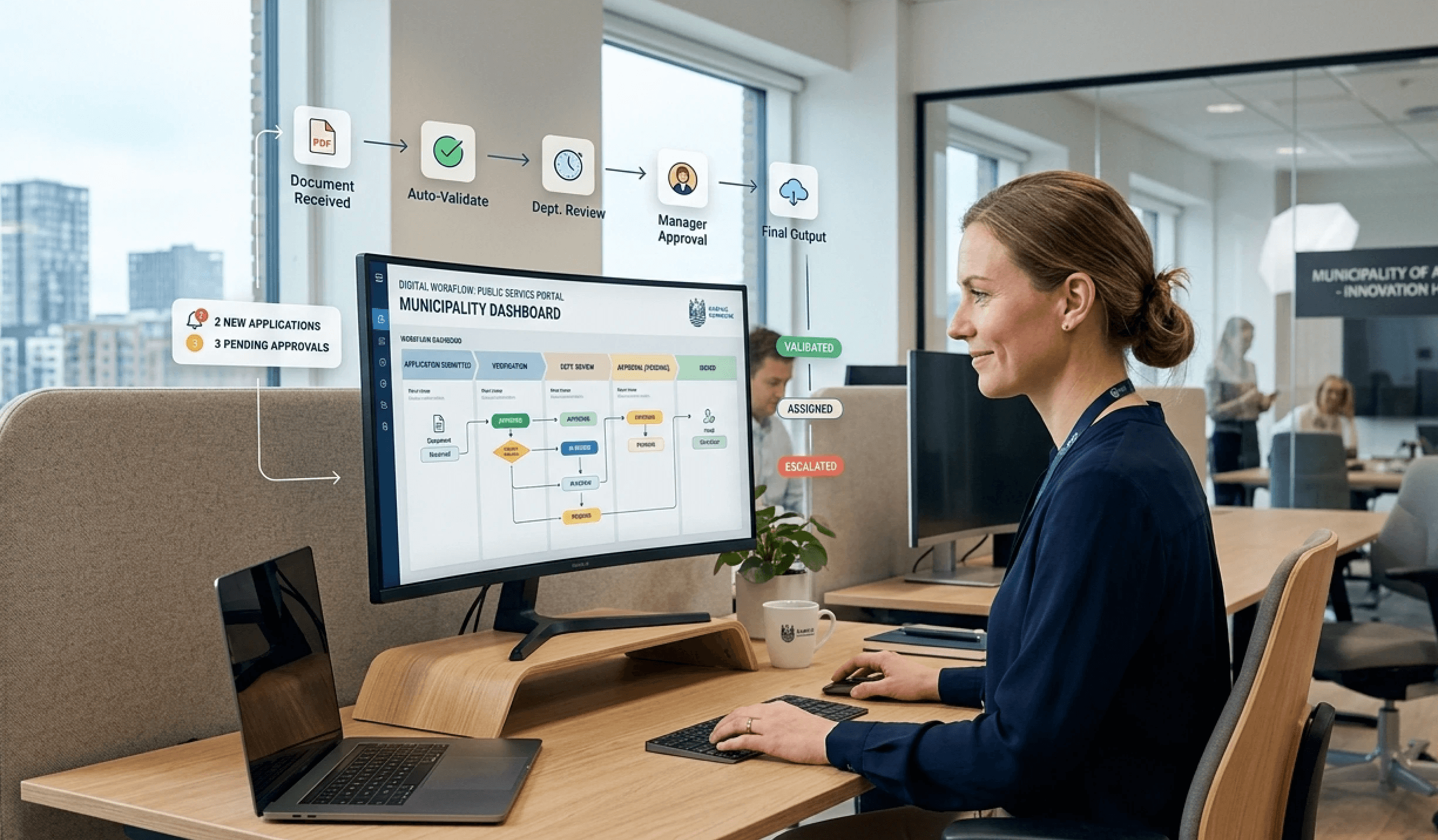
A nurse in a ward, a caseworker in a municipality, or a technician at a utility plant does not have time to search. When the current guideline needs to be found right now, a traditional document archive is of little help if the document is registered correctly but not made quickly usable in everyday work. This is precisely where a modern intranet and a traditional document archive demonstrate their practical differences.
In many public sector environments, employees end up in a system built for preservation and control, not for daily guidance. The archive may well contain the correct document, but it does not necessarily solve searchability, coherence, and quick access across roles and locations. That is why frustration is often not about a lack of discipline, but about using the wrong tool for the task.
Practical rule of thumb: If an employee needs to act on the information today, it is an intranet problem. If the information needs to be documented, retrieved, and preserved later, it is an archive problem.
This is also the reason why many organisations repeat the same mistakes. The same instruction might reside in the record system, in an email thread, and on a shared drive, while nobody is entirely sure which version applies. For a practical review of how critical knowledge can be retained, this review of critical knowledge during employee departure is relevant as a supplement.
When employees look for reliable operational knowledge, the problem is therefore rarely a lack of data. The problem is that data is stored in a system not designed for everyday use.
The difference between a modern intranet and a traditional document archive
A traditional document archive is an authoritative layer. It is built for filing, preservation, traceability, and legal certainty so that cases and documents can be documented later, even when the case is old. A modern intranet is a working platform that makes communication, knowledge sharing, and search part of daily operations.
Dimension | Traditional document archive | Modern intranet |
|---|---|---|
Purpose | Preserve cases and documents securely | Activate knowledge in daily operations |
Primary use | Filing, traceability, auditing | Communication, collaboration, search |
User situation | When documentation needs to be retrieved later | When employees need to act now |
Information structure | Formal cases and metadata | News, guidelines, processes, and operations |
Technical logic | Authoritative storage and control | Central working platform with quick access |
This difference becomes clear in public organisations where email, collaboration spaces, and professional systems are often used differently by individual teams. In early comparisons of public digitisation, it was already evident that email functioned primarily as a collaboration tool rather than an archiving system, and that document management remained a heavy function in state enterprises. DFØ's historical review of ICT in the public sector highlights precisely this dividing line.
The practical outcome is simple. The archive answers the question: "What is the official documentation?" The intranet answers the question: "How do we work with this today?" When the two are mixed, the archive quickly becomes cumbersome, and the intranet loses its value as a dynamic workspace.
A modern intranet and a document archive are therefore not competitors. They are different layers within the same organisation, and they solve different problems.
The hidden costs of using the archive as a knowledge base
When daily knowledge is scattered across email, local files, or shared drives, costs grow quietly. Not because anyone makes a dramatically wrong decision, but because many small frictions repeat themselves every day. Users work on copies of files, and versions, history, and responsibility quickly become unclear.
When documents branch out
A central issue in public sector environments is that documents are not just saved; they are copied. When someone downloads a file and adapts it locally, multiple variants of the same document quickly arise, making it hard to ensure who last modified what. This is exactly the type of version conflict that a central working platform with role-based permissions, audit trails, and controlled access is designed to reduce, whereas a traditional archive is not built for ongoing collaboration at the same pace. Dataprius' description of intranet and cloud storage points directly to this mechanism.
From an archival perspective, the picture also becomes heavy. In the Norwegian public comparison report, it was estimated as early as the early 2000s that approximately half of public enterprises had electronic services, that almost all municipalities used electronic records and archives according to the Koark standard, and that only 3% of email was subject to filing requirements. This point is important because it shows that much of daily communication was never intended as archival material. DFØ's historical source remains relevant as a background for modern working methods.
Material grows faster than usability
The Norwegian National Archives' (Arkivverket) public data also illustrates the heavy volume of material. In 2018, 48 million record entries were registered across state and municipality levels combined, whilst approximately 800,000 documents remained in status F, which did not make their way into public records. Municipalities accounted for 12.3 million record entries and around half a million status F documents, whilst the state registered 35.9 million record entries and nearly 250,000 status F documents. Arkivverket's review shows how much material ends up in the preservation logic without necessarily being easily accessible in daily operations.
When the archive becomes the primary knowledge base, the organisation pays twice: first for registration, then for finding what employees actually need to use.
The hidden costs are therefore not just about time. They are about errors, uncertain access to current instructions, and a growing support need because employees cannot determine which version is correct. This is also why a modern intranet often provides more value as an everyday interface, while the archive continues to do what it does best: preservation and control.
Why one system cannot solve both filing obligations and daily communication
It is tempting to look for one system that can do it all. Municipalities, regions, and other public organisations want to reduce the number of platforms, and this makes perfect sense, as long as the ambition does not become for one system to be a collaboration space, a knowledge hub, and an archive with full preservation logic. This idea collapses when looking at the requirements for metadata, traceability, and daily use.
The grey area is the hardest part
Research into public records management indicates that digitisation has pushed archiving tasks onto caseworkers, creating a persistent pressure on skills and workload in operations. The SCUP article on records management highlights precisely this grey area, which many projects underestimate: namely, what should go where, who owns the metadata, and how duplication is avoided between collaboration spaces, intranets, and archive systems.
The practical consequence is simple. If an organisation uses an archive as a daily communication channel, the system becomes overloaded with material not primarily created for preservation. Conversely, if the organisation uses the intranet as a legal preservation repository, it loses the security and structure required for public records. A modern intranet can therefore support the work, but it cannot replace an actual document archive when the goal is legal preservation, public access, and audit trails.
Two layers, not a single blended solution
The best model is therefore twofold. The intranet functions as an operational knowledge and communication hub, while the archive system functions as an authoritative preservation layer with fixed retention rules. This architecture also fits the technical reality in public environments, where system inventories and documentation requirements encompass all systems that register, process, or store archival documents. Arkivverket's guidance on electronic archive systems emphasizes precisely the responsibility for documentation, even when systems are hosted externally.
A single system can well be central. It just cannot be central for two opposing purposes at the same time.
In practice, this means management must choose the architecture according to the task, not for convenience. Daily communication requires a platform that can be shaped around the workday. Filing duties require a system that can withstand requirements for preservation, traceability, and control. Keeping these two roles separate also makes it easier to explain the boundaries to IT, legal, and business departments.
How to distribute content between the intranet and the archive
A good distribution starts not with technology, but with content type. If the organisation wants to avoid duplication, there must be clear rules for what constitutes working knowledge and what constitutes documentation of historical value. Otherwise, the same files will end up again in collaboration spaces, the intranet, and the record system.
What belongs where
Legal documents belong in the archive because they must be preserved, tracked, and retrievable later.
Daily updates belong on the intranet because employees need to act on them immediately.
Project files can reside in both places, but only if responsibility is clear and the current version is unequivocal.
News and policies should reside on the intranet, so the organisation has one dynamic entry point for current information.
Historical documents must go to the archive because they hold value as documentation, not as operational tools.
This model works best when metadata manages itself through governance. This means a department or role must be responsible for ensuring a document has the right status, the right home, and the right lifespan. If this responsibility is not assigned, duplication immediately occurs, and employees start guessing.
How to avoid version clutter
A modern intranet uses role-based permissions, audit trails, and controlled access so that employees do not work on different variants of the same document. This reduces version conflicts and enables traceability without overloading the archive system, which is an important difference in environments with many roles and locations. The technical description of version control and access is useful as a mental model, even when the organisation works with other platforms.
A good practice is to decide three things beforehand.
One source of truth: Each document must have one location where the active version lives.
One owner per document type: Metadata and maintenance must belong to a clear role, not a vague group.
One rule for archiving: When a document is finalized, it is moved or registered according to a fixed procedure.
Once these three rules are in place, the intranet does not become a new document store alongside the ERMS (ESDH). Instead, it becomes the interface where employees find what they actually need, while the archive continues to carry the documentation responsibility.
How Colibo supports public and critical organisations
Public and critical organisations need a working platform that can stand on its own feet while playing well with existing environments. Colibo is relevant in this context because the platform is built as an independent intranet layer with Danish and EU hosting, while also integrating with Microsoft 365 and Google Workspace. The technical point is not to replace the archive, but to make daily communication and knowledge sharing more manageable.
When compliance and usability must go hand in hand
In practice, it is crucial that the platform does not tie the organisation to a single collaboration suite. The stand-alone architecture means that a municipality, a hospital, or a utility company can organise its internal knowledge sharing without being locked into a specific ecosystem. This is relevant in environments where data sovereignty, operational control, and flexibility carry significant weight.
Colibo is also described as a platform with ISO 27001 certification and an ISAE 3000 audit, providing a documented compliance foundation in organisations with strict requirements. At the same time, it is vital that the mobile app and info screens can bring operations and news closer to the frontline, where employees are not always seated at a stationary PC.
The most important effect in practice is not fancy design. It is making current information accessible right where the work actually happens.
What the platform can do, and what it should not become
Colibo can function as an operational layer for news, employee information, and work support, even when the organisation works across multiple systems simultaneously. The built-in AI assistant uses the organisation's own intranet data for searches and content understanding, helping users find the right information faster. This makes the platform relevant as a supplement to the archive system, not as a replacement for it.
The critical part is precisely the boundary. If the intranet is used as a hidden archive, the organisation misses out on the control that the archive system is designed to provide. If, on the other hand, it is used as a dynamic workspace, it becomes easier to maintain one shared entry point for knowledge, without distorting the archival function.
Your next step towards a coherent digital workplace
The best decision is rarely to choose either an intranet or an archive. The strongest approach is to define which system should do what, and to sort out the grey areas before duplication and version clutter become a habit. When leadership, IT, legal, and operational areas agree on purpose and responsibility, it becomes much easier to obtain a solution that supports both operations and documentation.
Start by mapping three things within your own organisation. What knowledge do employees need today, what documentation must be preserved later, and which files are already moving between email, collaboration spaces, and records. This mapping quickly reveals where the intranet should act as the workspace, and where the archive should serve as the authoritative repository.
Thereafter, the organisation can address metadata ownership, access models, and transition rules between systems. This is where many projects succeed or fail, because technology only makes sense once the processes have been decided. A coherent digital workplace does not arise from more folders, but from clear roles and a platform that fits the way public operations actually function.
Colibo delivers a modern intranet platform that can unify internal communication, knowledge sharing, and daily work tools without interfering with the archive system's preservation duties. If a public organisation needs to align daily knowledge, frontline access, and compliance more effectively, Colibo could be a relevant place to start the dialogue.