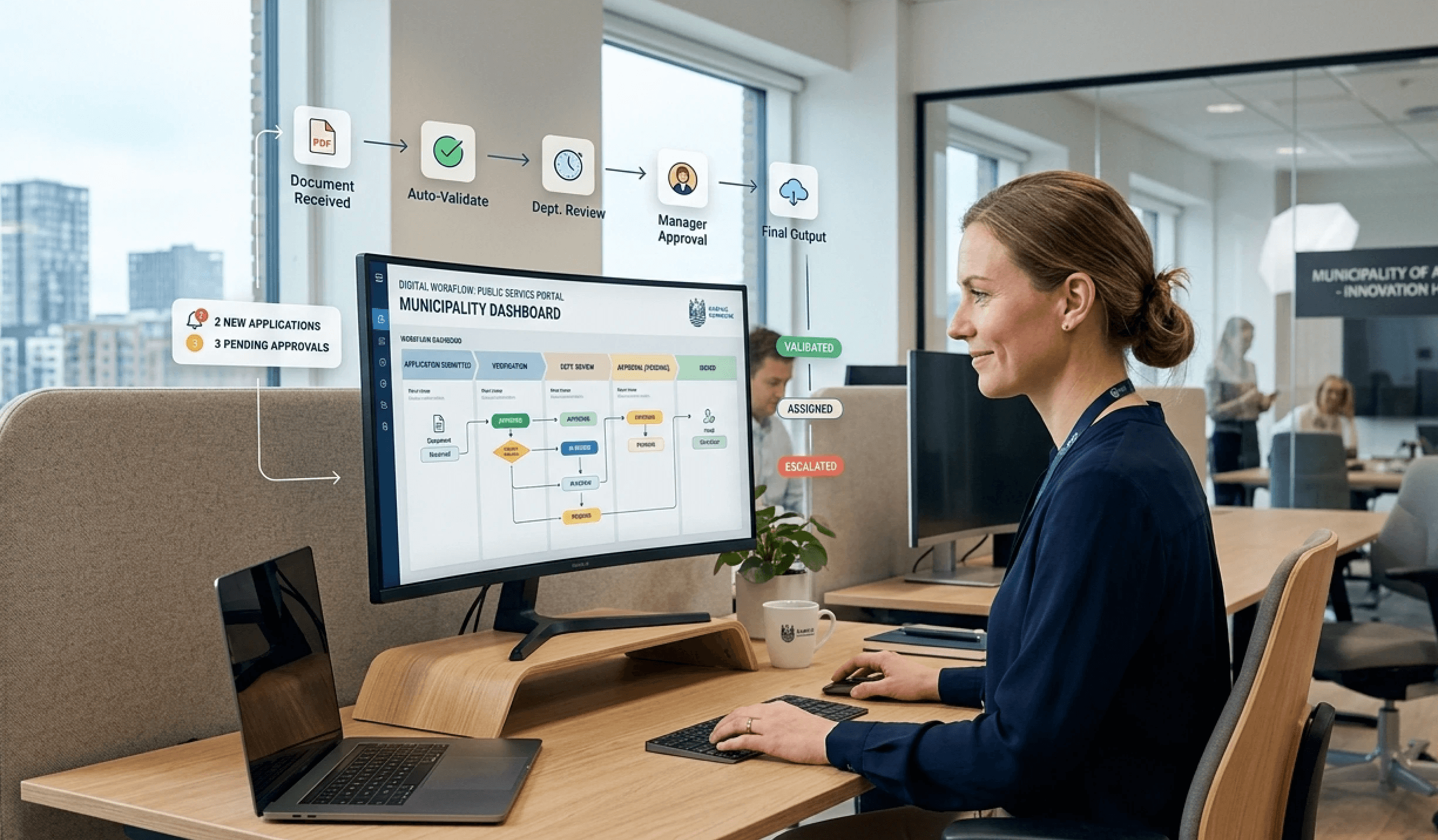


How do we improve internal communication in the transport industry?

The time is 05:30. A road closure forces operations to change routes before the first vehicles have left the terminal. The office sends an email. The terminal manager passes the message on verbally. The warehouse hears a shortened version. The driver, who is already on his way, sees nothing. Customer service is still working on the old plan.
This is how small communication errors become operational errors in the transport industry. Not because employees are not doing their job, but because information does not flow consistently between drivers, warehouse, terminal, dispatch, customer service and management.
The question, therefore, is not whether internal communication is important. The question is how do we improve internal communication in the transport industry so that the right message reaches the right employee in time, even when they are on the road, on shifts or without regular PC access.

Introduction: When a simple route change creates operational chaos
At 05:40, a route is changed because a customer moves their delivery window. The dispatcher gets the message. Two drivers do not. The warehouse picks according to the old plan. The terminal books a bay for the wrong time. Customer service promises a delivery that operations can no longer meet. Within less than an hour, one small change turns into delays, extra phone calls, waiting time and unhappy customers.
This is what communication errors look like in the transport industry. They do not just damage internal morale. They impact delivery reliability, resource consumption, safety and documentation on the very same day.
In many transport companies, the problem is not a lack of information. The problem is that the right message does not reach the right person quickly enough, through a channel they actually use during operations. That is the difference between an adjustment that goes through smoothly and a morning where the entire chain starts to struggle.
Internal communication in the transport industry must function under operational pressure. Otherwise, it is just noise.
I often see the same challenge in companies with drivers, terminal staff, workshops and administration spread across multiple locations and shifts. Messages are sent from different places, interpreted locally and followed up differently. The result is not just ambiguity. The result is that operations lose momentum because employees themselves have to spend time finding out what applies.
What typically goes wrong
The most common mistakes are rarely dramatic on their own. It is the combination that creates chaos:
Too many channels in the same operational situation: The dispatcher sends an SMS, the team leader calls, and the updated instruction is in an email. The driver acts on the first thing he sees. The warehouse acts on something else.
Multiple versions of the same message: A new loading procedure is printed and hung at Bay 3, but the workshop manager has received a newer version by email. The evening shift complies with yesterday's paperwork, while the day shift does something else.
Messages sent too widely or too narrowly: The entire organisation receives a general update about changed access conditions at one terminal, but the external drivers who actually meet the gate guard do not get it.
No reliable follow-up on critical information: A message is sent about new rules for load securing or dangerous goods, but no one can afterwards see who has read it and who is still driving according to old practices.
To solve this, communication must be treated as part of the operational structure. Not as a side project in HR or something that can be handled with another email. It requires dedicated channels, clear owners and a simple rule for where employees should look when plans change.
Why traditional communication fails in the transport industry
Email and noticeboards work fine in environments where employees sit at a desk and work during the same hours. This is not the reality in transport and logistics. Here, the workday is split across shifts, locations, vehicles, terminals, depots and customer contacts.
This means that deskless employees easily become the group that the organisation talks about, but does not actually reach. Industry experience indicates that frontline employees need regular check-ins, clear channel management and messages tailored to their specific roles, especially when they do not have fixed access to a computer. The real challenge is therefore not to communicate more, but to communicate more operationally (Sociabble on internal comms for transport and logistics).
Different roles have different needs
A driver needs something different from customer service. The warehouse needs something different from HR. Terminal management needs something different from finance.
A practical model often looks like this:
Role | Typical need | Bad channel | Better channel |
|---|---|---|---|
Drivers | Route changes, safety info, contact channels | Email alone | Mobile message and searchable knowledge base |
Warehouse teams | Changed procedures, staffing, operations | Verbal handover alone | Targeted feed and scheduled updates |
Terminal staff | Local messages, shift information | Paper and local copies | Role- and location-based communication |
Administration | Cross-functional information, documents | Scattered files | Shared digital workplace |
What does not work in practice
The following patterns almost always create noise:
"All-staff" messages as default: Employees quickly stop responding when too much is irrelevant.
Local improvisation: Every terminal finds its own way to share important information.
Communication without ownership: No one knows who updates procedures, FAQs or safety instructions.
Channel confusion: Employees do not know if the current message is in the email, the chat or on paper.
For companies working with internal communication in transport and logistics, the problem is therefore rarely a lack of will. The problem is that operational communication, frontline communication and knowledge sharing are not structured systematically.
The solution is a mobile-first digital hub
Operations become more stable when everyone works from the same version of reality. In the transport industry, this means one shared space for current procedures, operational news, safety information and contact paths. Otherwise, the classic error occurs: the terminal follows an updated instruction, while the driver still has yesterday's update in an SMS thread.
A mobile-first intranet solves this challenge by gathering news, documents, FAQs, operational updates and safety communication into a single workspace that also works on the move. Employees do not have to guess whether the answer lies in an email, chat, paper folder or with a colleague on the next shift. They need to be able to find it quickly, on their mobile, while work is ongoing.
Mobile first, not mobile as an add-on
If the solution is primarily built for the desktop, usage quickly drops among drivers, technicians and terminal staff. I often see this in implementations where the system works technically but never becomes a real part of daily operations.
The mobile must therefore be the main point of access. This applies to messages, documents, search and acknowledgements of important updates. A mobile app for employees on the go provides far better conditions for getting information out in time than a solution that requires logging in from a PC in the break room.
It has to work in practice:
Critical messages must be visible immediately
Documents must be openable and readable properly on mobile
Search must be fast enough to use between stops, loading and shift changes
Push notifications must be used with discipline, so only the important ones break through
What a digital hub should contain
In transport, the platform only works if it helps employees with their daily duties. An intranet that is mostly used for corporate news quickly becomes a side project. An intranet that clarifies doubts about procedures, contacts or the latest operational change gets used.
Practical rule: If a driver or terminal employee cannot complete a specific task faster using the platform, it will not become a part of their daily routine.
The shared reference point should, as a minimum, gather:
Operational updates: Route changes, local deviations, changed opening hours and emergency messages
Documents: Procedures, instructions, forms and correct versions
Safety information: Rules, reporting lines and contact points
Employee access: Contact directories, onboarding, HR information and relevant shortcuts
A modern intranet creates value not by adding another channel, but by connecting what should already be connected. This reduces errors, shortens response times in operations and makes it clear which information is applicable right now.
Stop the noise with targeted operational communication
At 05:40, a customer changes the unloading site for three deliveries. The dispatcher sends an email to everyone, writes in a shared chat and calls two team leaders. At 07:10, the wrong vehicle is still driving towards the old address. This is what noise looks like in transport operations. Not as too little information, but as too much information to the wrong people at the wrong time.
Targeted operational communication is therefore about cutting away. Drivers, terminal staff, the workshop and administration do not need the same messages. If everyone receives everything, the frontline quickly starts filtering everything out. Then the messages that actually require action get lost too.
Start by mapping the information flow
The first task is to find the bottlenecks in daily communication. In practice, this means reviewing what messages are sent during a normal week, who sends them, who needs to act on them and where they end up. Many transport companies discover here that the same operational updates are sent through multiple channels simultaneously while responsibilities and priorities remain unclear.
This pattern repeats in large organisations: Communication becomes more useful when local needs are mapped first, and when the responsibility for coordination is then clearly centralised, as also described earlier in the article.
A mapping workflow can be made simple:
Gather the roles: Drivers, dispatchers, warehouse, terminal, workshop, HR and management.
Describe their operationally critical information: Changes in routes, opening hours, deviations, staffing, safety and local conditions.
Map the actual channels: Email, telephone, boards, chat, verbal handovers and apps.
Agree on channel choice and responsibility: What is broadcast widely, what is targeted and who keeps the content updated.
Here, it is important to be realistic. A shared channel structure does not solve everything if operations managers still send urgent matters in private chat threads, or if local managers create their own shortcuts alongside the system. The rules must be able to function during shift changes, weekends and under time pressure.
Set rules for notifications and access
Targeting only works when there are clear rules for what is allowed to push through on the mobile. Otherwise, the noise just moves to another channel.
A model that often works in transport looks like this:
Push notifications: Urgent operational changes, safety warnings and tasks requiring action now
News feed: Scheduled updates, management information and updates without urgency
Knowledge base: Procedures, FAQs, HR information and documents
Local groups: Messages linked to a specific terminal, depot, route area or team
If everything is marked as important, employees quickly lose trust in the prioritisation.
Access management is part of the same exercise. A driver should only be able to see what is relevant to the route and the day's tasks. HR documents, management material and sensitive details should not lie open to everyone. This requires a solution where roles, locations and rights can be set up without manual extra work every week.
For companies looking for an intranet for logistics and transport, the point is simple: segmentation, mobile access and clear content owners are crucial for communication to work in daily life. This is especially true if the company also wants to retain experiences from veteran employees and make them accessible to new colleagues, as described in the article about preserving critical knowledge when employees leave.
Strengthen safety and compliance with easy access to knowledge
In the transport industry, safety communication is not a separate lane. It is a part of operations. When procedures are hard to find, or when employees are unsure about the current version, the risk of errors, unsafe behavior and inconsistent compliance rises.
Therefore, safety procedures, instructions and compliance-relevant information must reside in one place, be easy to search and be accessible on mobile. Employees should not spend time looking for the right PDF in old emails or local folders. They must be able to find the valid version instantly.
Two pathways in safety communication
Good safety communication goes in two directions:
Top-down: Critical alerts, updated instructions, changed procedures and requirements
Bottom-up: Observations, near-misses, ambiguities and suggestions for improvement from the frontline
It is this combination that makes a platform useful in practice. When employees can easily report an observation or ask questions about a procedure, operations can identify weaknesses more quickly.
An intranet can also help preserve critical knowledge when key employees change jobs or leave the company. This is particularly relevant in environments where a lot of knowledge otherwise resides solely with individual managers or veteran employees. This issue is described in Colibo's article on preserving critical knowledge when employees leave.
What the operations manager must demand
Safety and compliance become stronger when the platform supports:
One authoritative document version
Fast distribution of critical alerts
Mobile access to instructions
A simple way to report incidents and doubts
This is how safety communication becomes practical. Not as campaigns, but as something employees actually use in the middle of the workday.
Future-proof knowledge sharing with AI and effective onboarding
Many transport companies are not drowning in a lack of information. They are drowning in repetitive questions. Where is the current procedure? Which version applies? Who to contact in case of deviations? How do new employees do it right the first time?
This is where AI-powered knowledge sharing makes sense, provided it works on the organisation's own documents, procedures and FAQs. When employees can quickly find answers in existing knowledge, the pressure on managers, dispatchers and HR drops because fewer questions have to be answered manually.
AI is only useful in operations when it helps employees find the organisation's own answer. Not a generic answer.
An article on internal communication with AI describes exactly this approach, where AI is used to keep the organisation connected and informed based on its own data and content.
Onboarding must be consistent, not a local lottery
Onboarding is an area where many companies still improvise. A new driver gets one introduction. A new terminal worker gets another. A new colleague in the warehouse learns a third version, depending on who is on shift.
An intranet for transport should organize onboarding into structured journeys, so new employees meet the same basic framework:
Role-based introductions
Local instructions based on depot, terminal or function
Access to procedures, contacts and FAQs
Learning that can be accessed on mobile
This does not just create better training. It creates more uniform execution in daily operations. And it is often the assembly line to high adoption. When the platform helps the employee with concrete tasks from day one, it gets used.
Checklist for better internal communication in the transport sector
If the goal is to improve internal communication in the transport industry, the effort must be simple enough to work in operations and sharp enough to be measured.
Practical action checklist
Make mobile access the standard: Build communication for employees on the go, not just for the office.
Gather operationally critical information in one place: Procedures, safety, HR and operational updates must have a single source of truth.
Use targeted messages: Distribute by role, location, team and function to reduce noise.
Make knowledge searchable: FAQs, documents and instructions must be quick to find.
Prioritise safety communication: Critical alerts must be able to break through, and incidents must be easy to report.
Establish clear content owners: Each type of information must have a responsible owner.
Use AI where it makes sense: Let employees find answers in the organisation's own data.
Standardise onboarding: New employees must experience the same basic structure across locations.
Measure the impact continuously: Relevant KPIs include read rates on critical messages, time to first view on mobile, drop in repetitive questions and usage of the search function, as described in NIKKB's advice on corporate communication.
What should actually be followed up on
Danish professional sources indicate that internal communication improves the most when it becomes systematic, channel-based and measured regularly. Journalisten describes the need to translate strategy into a concrete plan for the next quarter, so everything is not communicated at once, and developmental trends in Denmark after the pandemic point towards a closer interplay between internal and external communication (Journalisten's guide to fine-tuning internal communication).
This matters in transport. Improvement rarely comes from more messages. It comes from better structure, clearer timing and consistent feedback loops.
Conclusion: From fragmented operations to a unified organisation
How do we improve internal communication in the transport industry? By treating it as what it is. An operationally critical discipline.
Transport companies do not manage communication by broadcasting more. They manage it by gathering information in one place, making it mobile-friendly, targeting it by role and location, ensuring easy access to procedures and tracking whether messages are actually read and used. This is how internal communication in the transport industry transitions from being fragmented to supporting safety, alignment and day-to-day operations.
When drivers, warehouse, terminal, operations and the office work from the same page, misunderstandings drop, and decisions can be made faster and more safely.
Do you want to unify internal communication, operational information and employee access in one platform? See how Colibo helps transport and logistics companies reach employees on the move and create more alignment in daily life.