

Questions and answers about intranets in the transport industry

Many transport companies find themselves in the same position when the talk turns to intranets. Operational messages lie in email inboxes. Safety instructions are in a shared folder that only a few can find. Route changes are given verbally, by phone or via text message. HR puts something on the noticeboard, while the terminal uses its own local solution.
This does not just cause irritation. It creates uncertainty in operations. In practice, drivers, warehouse, dispatch and office work based on their own separate information picture, even though they should be working from the same one.
That is why Questions and answers about intranets in the transport sector are rarely about which platform looks the neatest. It is about how to get information to flow correctly in a reality with changing shifts, multiple locations and employees who are rarely sitting at a PC.
From chaos to clarity. The start of a better intranet
The first step is almost always the same. The way the business already communicates needs to be cleaned up. Not in theory, but in practice.
In many transport environments, information has been built layer upon layer over time. Some is in the TMS, some in emails, some on paper, some in local Excel sheets, and some only exists with the experienced shift manager. When a company then decides to implement a new intranet, it is tempting to start with features, design and vendor lists. That is the wrong order.
Everyday life reveals the problem
A typical scenario looks like this. Dispatch sends an important message to a group of drivers. A terminal manager forwards it to a few. Another gives the message verbally at the gate. In the office, everyone is assumed to be informed. On the road, there is still doubt as to which instruction applies.
This is where the intranet either becomes an asset or just another system that people skip.
Practical rule: If the company does not know where the information lives today, it cannot build an intranet that employees actually use.
A clearly underserved question in Danish transport is not what an intranet is, but how it works for drivers, warehouse and office simultaneously, especially when many employees are mobile and need short operational signals rather than a classic office page, as described by Colibo on mobile employees' information needs.
One shared digital workplace
The right starting point is to define the intranet as one shared digital workplace. Not as an internal news site. Not as an archive. And not as a copy of existing systems.
It must be the place where employees can quickly find the applicable information, regardless of whether they sit in traffic control, stand in the warehouse or are en route between deliveries. Once that mindset is in place, it also becomes easier to assess whether an intranet for internal work processes and information sharing fits the daily operation.
The difference between an intranet that works and one that gathers dust rarely lies in the technology alone. It lies in whether the solution takes as its starting point the communication confusion that employees already live with.
Map your information flow before choosing a platform
Proper mapping does not require a large analytical apparatus. It requires discipline. Specific questions need to be asked, and the answers must be gathered in one place.
Start with everyday life, not features
Begin by mapping these information types:
Operational messages. Where are route changes, terminal delays and urgent updates shared today?
Procedures. Where are active work descriptions located, and who updates them?
Safety instructions. How do drivers and terminal employees access them when they actually need them?
HR information. Where do employees find answers on holidays, absence, onboarding and contact persons?
Local special rules. What things exist only in individual departments, and who knows they exist?
Do not just write down where the information is located. Also write down who owns it and how employees access it. This is often where the gaps become visible.
A Danish academic review describes 64 examples of shortcomings in transport statistics over the last 100 years and points out that deviations of 20% are not uncommon within individual sectors, underscoring the need for a single central and reliable internal source of definitions, methods and current documents in transport companies, as reviewed in Trafikdage's review of transport statistics uncertainties.
The same principle applies in daily operations. When multiple versions of the truth exist, errors occur not only in reporting but also in execution.
Ask the right groups the right questions
You need to speak to those who use the information under pressure. Not just with management and IT.
A simple interview round should include:
Drivers. Which messages are hard to get in time, and what do they typically look for on their mobiles?
Warehouse and terminal. Which instructions change frequently, and where do misunderstandings arise between shifts?
Dispatchers. What questions do they get over and over again, even though the answer already exists somewhere?
HR and managers. What content is shared broadly, but read incorrectly or too late?
The questions should be simple and concrete:
Question | What it reveals |
|---|---|
Where do you find the latest version of a procedure? | Whether the employee actually knows the authoritative source |
Which messages often arrive too late? | Where communication breaks down |
Which channels do you use during a normal shift? | How many switches there are between systems |
What do you still call to get clarified? | What content the intranet should resolve first |
There is an important lesson in other industries too. Work on how to build with quality and save time shows the same basic principle: standardisation only works when employees can find the same applicable proof without searching in multiple places.
It is also worth looking at how internal communication in the transport sector can be improved, because the problem is rarely a lack of information. The problem is dispersion, timing and relevance.
When drivers, warehouse and office describe the same problems with different words, it is normally not a training problem. It is a structural problem.
From insight to action. Set goals and choose the right tools
Once the friction is mapped, it must be translated into goals that operations and management can feel. This is where many projects go wrong. They choose a platform based on features before they have decided what employees actually need to be able to do faster and more safely.

For Danish transport and logistics organisations, a strong intranet is relevant because it can gather internal communication, knowledge sharing and operational tools into one closed platform that matches the need for quick clarification and secure communication across locations, as described in Omnia's review of the intranet as a closed internal platform.
Goals must be close to operations
A good goal is not "we must have a modern intranet". A good goal sounds more like this:
Drivers must be able to see operationally critical changes on their mobiles without calling in first
Dispatch must spend less time repeating the same instruction
Warehouse and terminal must find applicable safety notes without asking a manager
HR information must be targeted to the relevant groups instead of sent broadly
These goals make it easier to choose tools correctly. Not everything should live in the intranet. A TMS must still be the master for routes, deliveries and operational data. The intranet, on the other hand, should function as the communication layer, access path and common context.
An example from real operations
A classic situation is the acute route change early in the morning. Previously, this sort of thing was often handled via telephone chains, emails or local handover. This works, until someone does not answer the phone, or two links convey the message differently.
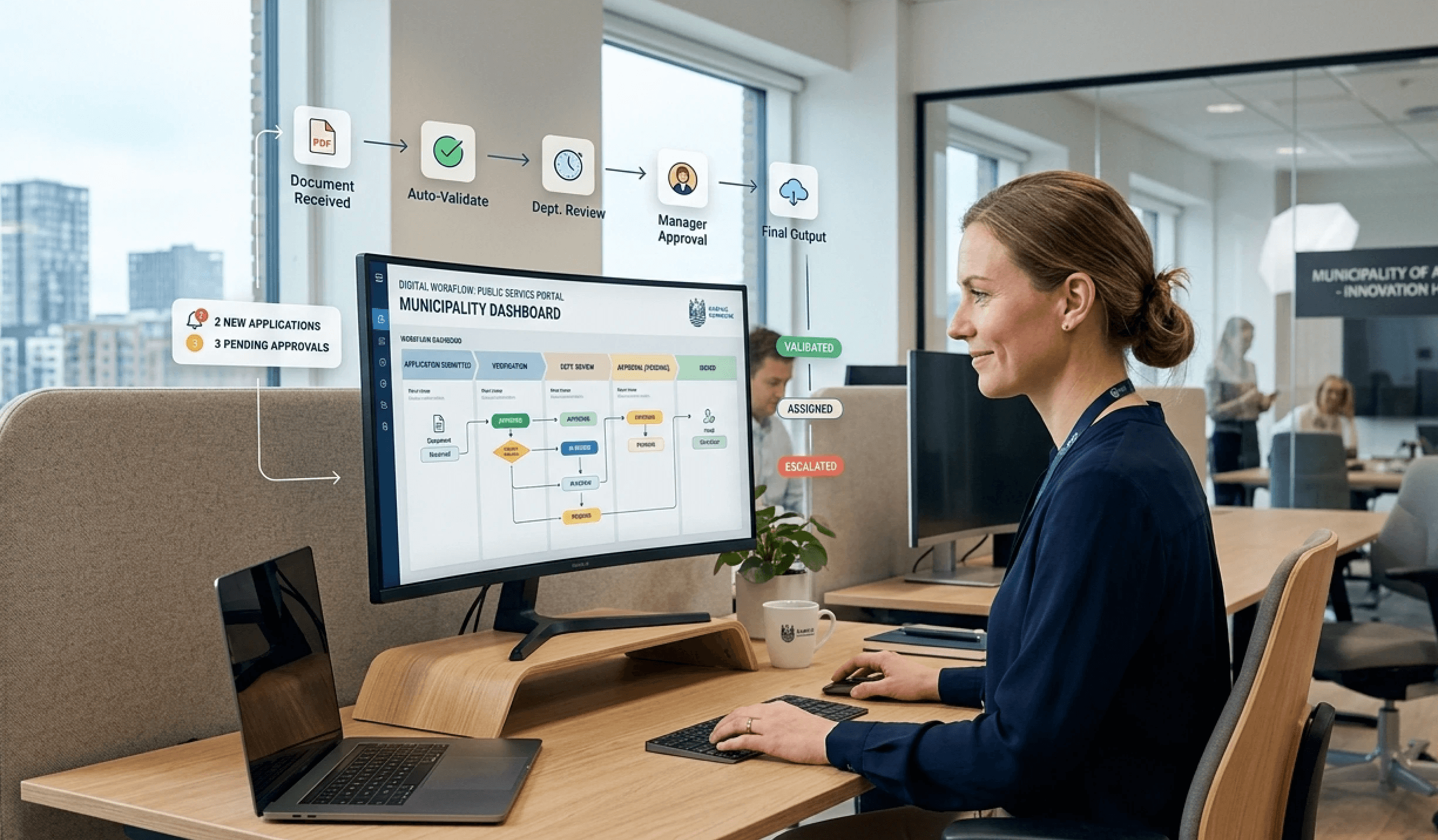
The more effective solution is targeted messages to the relevant drivers with direct access to the updated information. Here, it makes sense to use a platform like Colibo, where the intranet, mobile app and any info screens can gather messages, documents and role-based access into the same workflow.
The crucial part is not that the employee sees all data. The crucial part is that the employee sees the right action at the right time.
A driver rarely needs the full system picture. The driver needs the applicable message, the relevant contact and the correct document version.
Therefore, the choice of tool should always be evaluated based on three questions:
Evaluation point | What works | What typically does not work |
|---|---|---|
Mobile access | Short messages with direct links to action | Heavy homepages and many clicks |
Role basing | Targeting by route, location or function | Everyone sees everything |
Integration with TMS | Clear separation between operational data and communication | Double maintenance of the same information |
When these choices are made correctly, technology becomes a support for operations instead of another layer on top of it.
How to ensure a successful roll-out from day one
Implementation rarely fails because the platform lacks features. It fails because employees meet a system without clear roles, without relevant content and without a simple start.
A phased implementation, where you first establish 1-3 primary goals, uncover user needs, define governance and run a pilot phase, typically reduces the risk of errors by identifying issues early, as described in Oak Engage on phased implementation of intranets.
Before the first working day
The most important thing before launch is not branding. It is access, content and accountability.
The following must be in place:
Clear content owners. Who updates operational information, procedures, HR content and safety documents?
Permissions and target audiences. Who should see what, and which groups require specific targeting?
A pilot group. Choose employees from the driver group, warehouse, dispatch and office. Not just the digital frontrunners.
A limited starting content. Launch with the most important things first. Active procedures, contact channels, operational updates and a few permanent shortcuts.
If everything is loaded at once, the homepage becomes heavy, the search cluttered and accountability unclear.
First day and first habit
On the first day, employees must experience that the intranet helps them with something concrete. Not with everything. Just with something important.
This could be:
an operational update targeted to the right group
a safety instruction that is easy to open on mobile
a contact directory that reduces 'calling around' behaviour
a shortcut to TMS or duty roster, so the employee does not have to search
Important to remember: The first experience must be brief, useful and relevant to the individual role. Otherwise, the intranet quickly loses credibility.
For mobile employees, onboarding is best when it happens close to the task at hand. Drivers do not need a long desk-based introduction. They need simple activation, a brief explanation and a message that makes sense on the same day.
The first 90 days
The first few months determine whether the solution becomes a habit or a detour. Here, management and local key users must follow up on usage patterns and content quality.
A practical rhythm might look like this:
Period | Focus | What needs to happen |
|---|---|---|
Before launch | Clarity | Ownership, target audiences, pilot and starting content |
Week 1 | Credibility | The first important messages and quick support |
Week 2-4 | Adjustment | Correct navigation, targeting and content based on feedback |
Months 2-3 | Habits | Make the intranet the default place for specific workflows |
This is also where governance must stand its test. If old documents are left behind, or if multiple departments publish the same type of message in their own separate ways, trust quickly declines.
A good roll-out makes one thing very clear to the organisation: What should the employee go to the intranet for, and what should still happen in the other systems?
Measure the intranet's impact on your operations and bottom line
An intranet should not be measured like an internal newspaper. It must be measured as a work tool. Therefore, it makes more sense to look at behaviour and operational impact than at raw visitor numbers.
Denmark has built up large and complex transport data sources over time. According to Statistics Denmark on the transport sector, DTU's Transport Habit Survey shows that since 1992, around 400,000 interviews and more than 1 million trips have been registered, making the database one of the largest in the Nordic region. This kind of complexity makes internal dissemination and standardisation important, also in companies where managers, planners and operations must work based on the same understanding.
KPIs that make sense in transport
The most useful measuring points lie close to daily operations:
Read rate on operationally critical messages. Shows whether the relevant employees actually see route changes, safety messages and terminal updates.
Time to first view. Provides a picture of how quickly urgent messages are opened after publishing.
Mobile usage. Reveals whether the solution works for drivers, warehouse teams and others who work away from the desk.
Repetitive questions to dispatch, HR and managers. If the same questions persist, the content is either hard to find, unclear or poorly targeted.
Searches and document views. Shows which procedures and instructions employees actually need in their everyday lives.
Use of notifications. Helps distinguish between noise and messages that actually trigger action.
Double documentation. A drop in local copies and parallel versions is a strong sign that the intranet has become the reference point.
These measuring points must be read as a whole. High activity is not in itself a sign of success. If employees open many pages but still call dispatch to confirm the active version, the problem is not solved.
The most important sign of success
The strongest signal is trust. When drivers and terminal employees experience that the information they find is the latest and active version, their behaviour changes. They search less, clarify faster and skip fewer intermediaries.
This is also where the bottom line is indirectly affected. Not necessarily through one big measurable gain, but through fewer interruptions, fewer misunderstandings and less double work in everyday life.
The best intranet is not the one employees talk about the most. It is the one they go to without thinking about it, because they know the answer lies there.
From information channel to strategic operational tool
An intranet in the transport sector must be evaluated on the same criteria as the rest of the operations. Does it help employees carry out their work more safely, more consistently and with fewer interruptions?
When the company starts by mapping the information chaos, the implementation becomes sharper. When the goals are formulated as concrete operational needs, the choice of platform becomes simpler. When the roll-out takes drivers, warehouse, dispatch and office into account separately, adoption becomes higher and resistance less.
The crucial part is that the technology is adapted to the work situation. Not vice versa. In transport, this applies especially to mobile employees who need short messages, clear targeting and quick access to active documents.
Therefore, an intranet is not just a digital noticeboard. It can become the common reference for communication, procedures, access points and local decisions across locations. For companies working with many divisions and shifting operational situations, this is exactly why an intranet for logistics and transport makes sense as an organisational tool.
When set up correctly, the intranet shifts from being an information channel to being a part of daily management. That is where the value arises.
If the need is to gather internal communication, documents and operation-focused workflows in one place, Colibo may be relevant to evaluate as a platform. The focus should be simple: whether the solution fits employees on the go, role-based communication and the way information actually flows in the company today.