

Secure file sharing for public and critical organisations

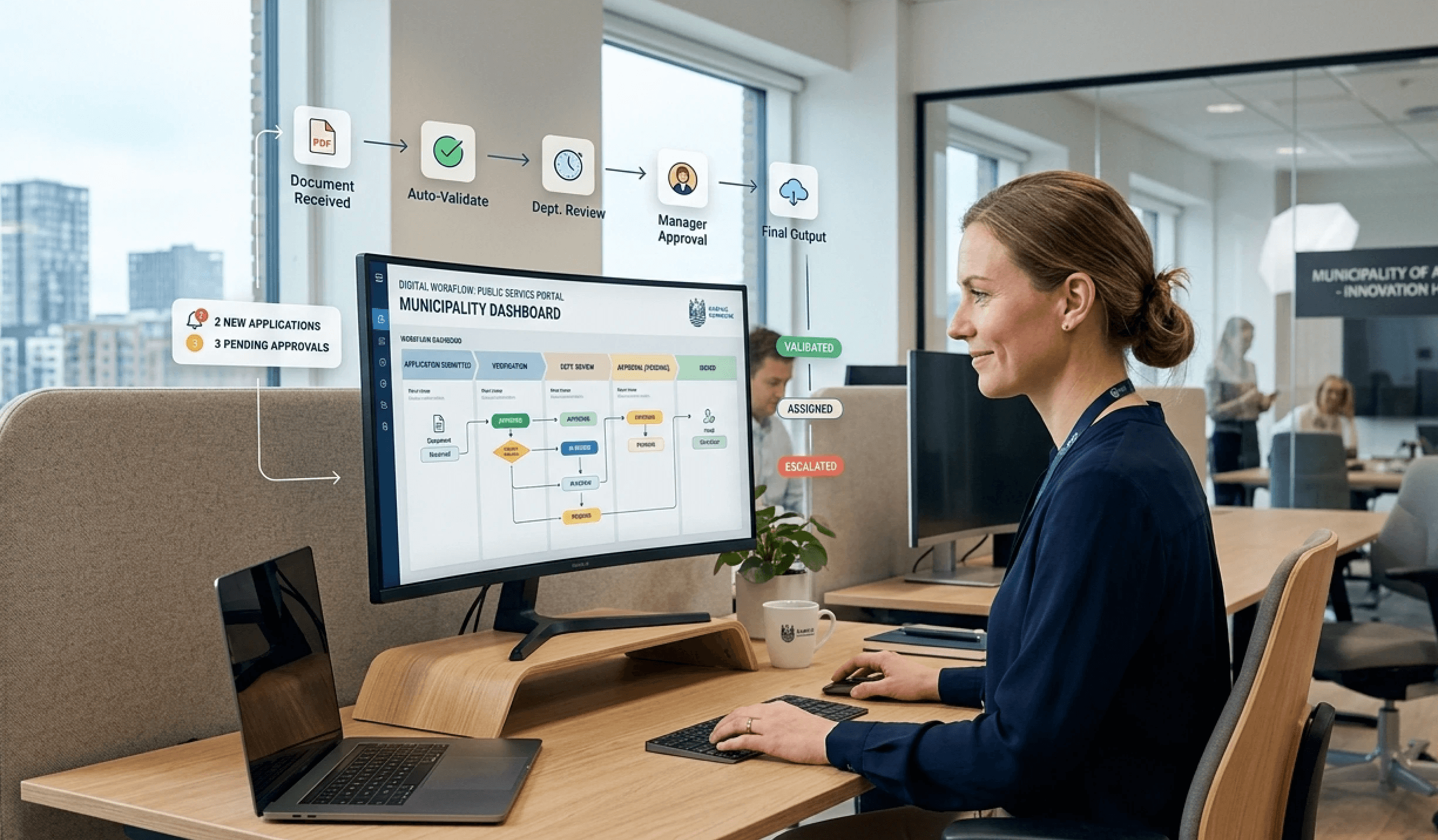
You are likely sitting in a daily routine where files fly between departments, suppliers, and managers, and where no one really has time to stop and ask whether the sharing is actually controlled. A caseworker sends an attachment to an external party, a technician puts a log file in a free service to get help quickly, and an HR employee forwards a document to the wrong recipient. It is precisely there that secure file sharing becomes a management responsibility, not just an IT choice.
When organisations choose the easy way, documents often end up in email threads, private folders, and services that no one really owns. It is not out of ill will; it is the absence of a better standard. Therefore, a good solution must make it easy to do the right thing and difficult to do the wrong thing, even when the daily pressure is on. Read also about protected document management in an internal environment on Colibo's data protection page.
When a sensitive file ends up in the wrong places
An employee in a local authority needs to forward a case attachment quickly. Things are busy, and the recipient is outside the organisation, so the solution becomes a free cloud service or a quick forward in an email. Technically, the files land fine, but not in a controlled space, and that is where the problems start.
The same pattern repeats in healthcare, utilities, and administration. A personal data file is sent to the wrong address. A technician uploads a log to a service that no one in the organisation has approved. A manager shares a document with an external party without any time limit or traceability. Each incident seems small, but the sum of them is what creates vulnerabilities.
Practical rule: If a file can be shared without identity, without expiration, and without logging, it is not shared securely. It has simply been made accessible.
This is due to the absence of a better standard, not ill will. Many compliance officers believe the problem is only encryption, but encryption does not solve wrong recipients, subsequent uploads, widespread copies, or unclear access control. A controlled sharing setup must be able to restrict access from the start and close it again when the purpose is fulfilled.
In a Danish context, it is not just about technology, but about steering the organisation away from improvisation. A solution for secure file sharing must fit into a local authority, a utility company, or a hospital, where people work differently but still need to share confidentially without guessing. This also requires that file handling supports data protection in practice, so documents do not take on a life of their own.
What secure file sharing actually is
Secure file sharing is not just a file behind a login. It is a controlled process where a file is shared with an identified recipient, protected by access management, and can be closed again after use. If that definition is not clear within the organisation, you end up calling everything from email attachments to open cloud links "secure", and that does not hold up.
Three things must be in place
First, the file must be protected. This means the content must not be left freely readable to anyone, and the transport between sender and recipient must be managed. Next, the recipient must be known, not just a random address that can be forwarded further. Finally, access must be time-limited, so the file does not circulate longer than necessary.
That part can be explained very simply. A key without a guest list is too risky. A guest list without an expiration date is too loose. An access card without control over when it expires is also not enough. It is precisely the combination that makes the difference.
What it is not
Standard email, USB drives, and free services are not secure just because they are convenient. They may have their place in workflows, but they rarely provide the combination of control, traceability, and expiration that sensitive documents require. Email is particularly weak when used as the default channel for everything that should be controlled.
The decisive factor is therefore not whether something can technically be sent. The decisive factor is whether the organisation can document who got access, why they got it, and when it ceased. If those three questions cannot be answered, the sharing is not truly under control.
The four risks Danish organisations underestimate
The first risk is the most common: accidental data leakage. A file ends up with the wrong recipient, a sharing link is forwarded, or a document sits in a system that more people than necessary can access. It often looks harmless at the moment, but the consequence grows quickly because a file can be copied further without anyone noticing.
GDPR breaches and documentation
The second risk is that sharing without control becomes a documentation problem, and quickly also a data protection problem. The critical point is not just whether a solution can send a file, but whether the organisation can show who got access, on what basis, and when the access ceased. Without that control, secure file sharing becomes just another channel that employees use differently from case to case, and then responsibility slips away.
What the supervisory authority looks for is not just the tool. It is whether the organisation can prove that the tool is actually used in a controlled manner.
Data sovereignty and jurisdiction
The third risk is the loss of data sovereignty. When sensitive documents are sent through services outside EU control, the issue is not only about encryption, but also about who can come into contact with the data and metadata, and what jurisdiction applies in practice. For local authorities, utilities, and other environments with a high degree of public or critical data handling, this is a management decision, not a detail that can be left to the individual employee.
Ransomware via sharing links
The fourth risk is the spread of attacks and malware through sharing links and uncontrolled file circulation. Here, the problem is very concrete. A compromised account must not give the attacker free access to the entire file area, and a shared link must not act as an open backdoor into the organisation's documents. This is precisely why controlled access, least privilege, and strong authentication must be set up, as described in the NSM's Basic Principles for ICT Security.
When files circulate freely, the attack often follows. You do not stop that sort of thing with more emails and more warnings, but with a managed process where access is restricted from the start.
It is daily practice that determines the risk. Not just the big, dramatic incident alone, but the small choices about where files land, who can see them, and how long they linger. A controlled sharing process makes those choices visible. Random file exchange via email or free services makes them invisible. Integration with the rest of document management is also crucial, and therefore secure file sharing should be viewed alongside document management in a managed solution, not as something that can run on the side.
Technical building blocks of a secure sharing solution
A proper solution for secure file sharing consists of several layers that must work together. If just one layer is missing, you are left with a nice surface and a weak core. This is why many solutions look solid in a sales pitch but fall apart when they need to be used in a local authority, a utility company, or another organisation with real demands for control.
Access and identity first
Strong authentication and role-based access are the foundation. Aula is a good Danish example of the principle, where secure files can only be viewed or edited by users with the right group permissions, and where access requires 2-factor login Aula's secure file documentation. This is not a specific school problem; it is the same discipline that any organisation with sensitive documents should demand.
When rights are managed by role and need, exposure falls significantly. This aligns with the NSM principles of least privilege, so a compromised account does not give the attacker free access to the entire archive. This type of management works because it limits the damage before it occurs.
Encryption, logs, and protocols
Encryption in transit and at rest is necessary, but alone it solves nothing. Without audit logs, you do not know who has accessed a file, and without time management, you do not know when access should stop. Standard protocols like SFTP, HTTPS, and API-based integrations make it possible to build sharing into an existing environment without forcing employees to take manual detours.
Good security is built through a set of controls that support each other, rarely through a single feature.
This is also where solutions must be assessed on whether they can integrate into the way the organisation already works. A platform like Colibo can function as a managed layer for sharing and collaboration, but the point is broader than a specific product. Sharing must reside in a controlled environment, not in random folders, inboxes, or free services. See also document management in a managed solution if you want to combine sharing and control in the same setup.
Cloud, on-prem, and Danish hosting in practice
The choice between standard cloud, on-premise, and Danish or EU-hosted cloud should not be decided by habit. It should be decided by how strict the requirements for control, integration, and data sovereignty are. A small local authority and a utility company with critical operations do not necessarily end up with the same answer.
What sets the models apart
Parameter | Standard cloud | On-premise | Danish/EU-hosted cloud |
|---|---|---|---|
Data sovereignty | Often weaker control over jurisdiction and sub-contractors | High internal control, but requires in-house operations | Better control, if supplier and hosting are clearly defined |
Integrations | Typically strong with Microsoft 365 and Google Workspace | Can be more demanding to operate | Can often be integrated if the platform is built for it |
Financial predictability | Can be simple to get started with, but less clear over time | More predictable internally, but requires own resources | Often a good compromise for organisations wanting control without full in-house operations |
High-security use | Not always suitable without specific requirements | Well-suited if the organisation can run it internally | Well-suited when compliance and location must be documented |
What fits whom
A smaller local authority often needs a model that fits into Microsoft 365 or Google Workspace without great complexity. Here, it is about getting control over access, logging, and expiration without creating a new IT island in the middle of the organisation. On-premise makes sense when internal requirements are strict and operations can be handled locally.
Utilities, healthcare, and other high-security environments should place more emphasis on control, integration options, and documented compliance. Colibo itself describes operations as cloud or on-premise with the option of Danish/EU hosting, and it is precisely that type of choice that makes sense when data sovereignty is non-negotiable.
The important thing is not to choose the "modern" model. The important thing is to choose the model where the organisation can actually manage data, support, and auditing in everyday operations.
Policies, training, and incident response
Technology without behavior ends in workarounds. Employees will find a shortcut if the approved process is more cumbersome than email or a shared folder, and then the organisation has simply moved the risk elsewhere. Therefore, policies, training, and contingency plans must be just as concrete as the solution being implemented.
Clear ground rules
A good policy must state exactly what may be shared, how it must be shared, and when the employee must use an approved solution instead of a free channel. Document classification helps because the employee does not have to assess the risk case by case. Supplier management must also be included, so external parties do not simply choose the easiest but least controlled path.
The rules must be short enough to be used in practice. If the employee has to search for the answer in a long document, they will choose the fastest solution, and that is rarely the right one.
Training that is actually used
Training must be short, concrete, and close to everyday tasks. A half-hour walkthrough of how to share a file securely is worth more than a thick policy binder that no one opens. This is especially true in local authorities and utility companies, where employees already work in many systems and do not have time to translate security into their own daily practices.
Training must be based on the mistakes that actually happen. People send to the wrong recipient, forget expiration dates, or use an unofficial channel because it is quicker. These are the scenarios that training should make easy to recognise and hard to repeat.
Response when something goes wrong
When a file ends up in the wrong place, a plan must be ready. Who assesses the incident, who stops access, who documents it, and who decides if there is a reporting obligation? The Danish Data Protection Agency's rules and guidance indicate that personal data breaches must be handled as a formal process, not as an ad hoc solution.
This is where many organisations fail. They have a policy on paper, but no practiced process when a file has been sent incorrectly, or when an external recipient has received more access than planned. Then you lose time, overview, and credibility all at once.
An organisation is not mature until it can handle an error without improvising.
This is also where a broader operational discipline helps. A solution for secure file sharing should be thought of together with the organisation's other business continuity work, so it holds up when the pace quickens and something needs to be restricted quickly. For an internal coherence on stable operations, Colibo's work on business continuity is relevant as a framework for this type of thinking.
Checklist and recommendations for Danish organisations
The short version is this. If the organisation cannot answer yes to most of the points below, secure file sharing is still a project, not a practice.
Level 1, what must be in place to avoid chaos
Approved sharing channel: There must be one or a few approved solutions that employees actually use.
Identity-managed access: The recipient must be identifiable, and access must not rely on open, uncontrolled links.
Expiration and revocation: Shared items must be closeable once the task is completed.
Logging: The organisation must be able to see who has opened or shared the file.
Level 2, what characterises a well-run organisation
Role-based permissions: Access must follow the task and need, not broad convenience.
2-factor login: There must be strong authentication in sensitive areas.
File classification policy: Employees must know what may be shared where.
Supplier management: External solutions must be assessed on access, location, and audit trails.
Level 3, what demonstrates documented data sovereignty
EU or Danish hosting: The organisation must be able to justify where data is located.
Integrated workplace: Sharing must be linked with the intranet, Microsoft 365, or Google Workspace, so users do not fall back on email.
AI without data leaks: If AI assistants are used, they must work on the organisation's own data in a controlled environment.
Audit readiness: The question "can it be documented?" must be answerable without panic.
If the organisation wants to choose wisely, the solution must not just be able to send files. It must be able to integrate into the digital workplace as a managed part of daily routines. This is where solutions with Danish or European hosting, integrations, and internal knowledge sharing make sense, because they move secure file sharing from random file exchange to a part of overall governance.
If the local authority or utility company wants secure file sharing that can actually be operated in practice, the solution must fit the workflows, not the other way around. Colibo offers an intranet platform that can be used with Danish or EU hosting, integrates with Microsoft 365 and Google Workspace, and serves as a managed environment for internal communication and knowledge sharing. Visit Colibo and assess whether your current sharing patterns should be consolidated into a more controlled setup.