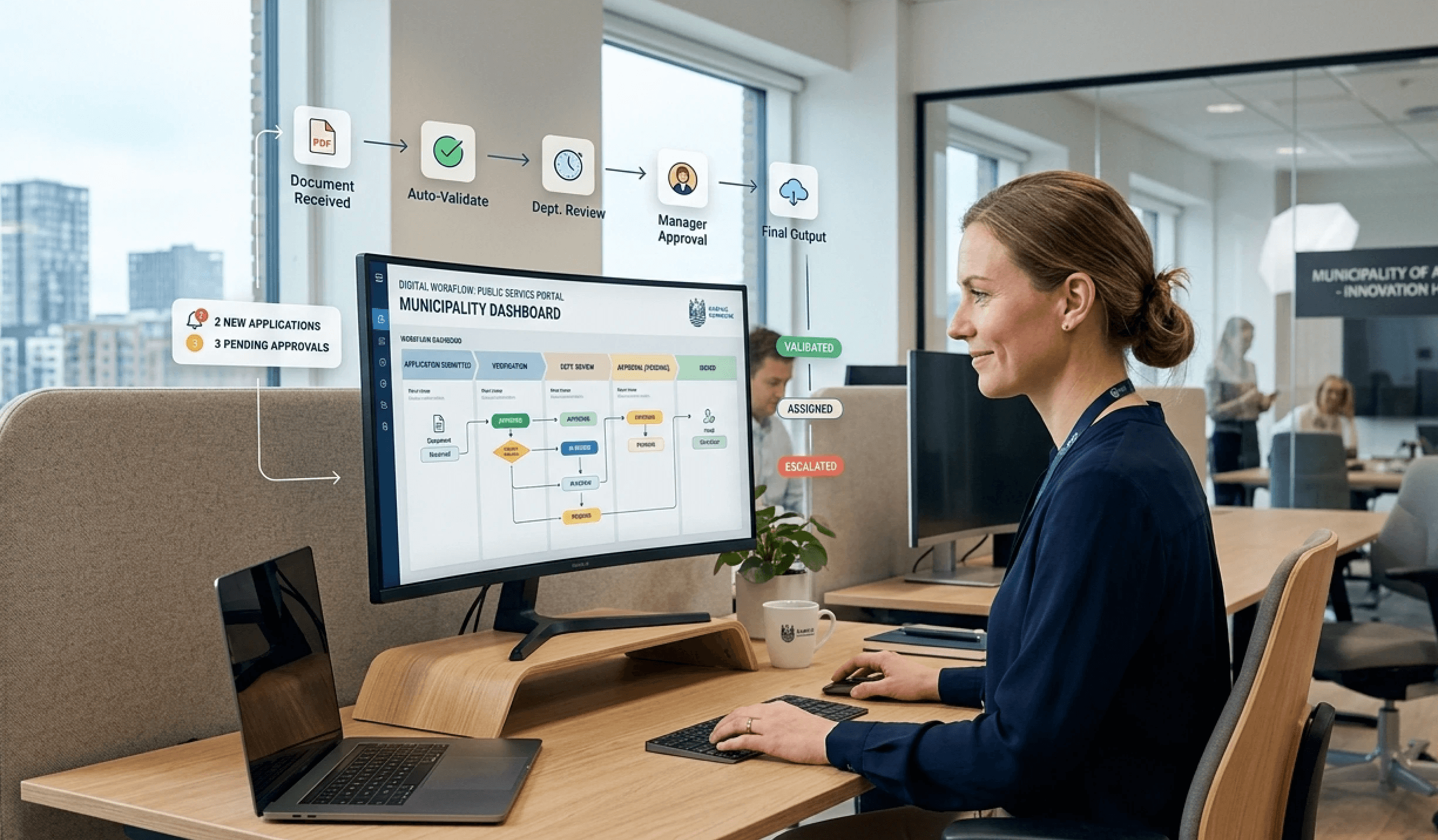


Cross-functional collaboration: Strengthen collaboration across departments

A case is sent from one department to another. A citizen waits. An operational task stands still. A project meeting ends with agreement in the room, but without changes in everyday life on Monday morning. This is how cross-disciplinary collaboration typically fails in large public organizations. Not because employees lack goodwill, but because the structure, goals and tools pull in opposite directions.
The classic frustration is recognisable. The social sector works from one logic. Environment and technology from another. HR talks about competences. Finance talks about management. IT talks about security and operations. Everyone does their job properly, but the big picture is missing. When that happens, "cross-disciplinary collaboration" is reduced to a nice ideal in a strategy, instead of a working method that actually solves problems faster and in a more coherent way.
The crucial question is therefore not whether the organisation wants better cross-disciplinary collaboration. The question is how to make it operational when hierarchies, local KPIs and disconnected systems stand in the way.
Why effective cross-disciplinary collaboration is crucial now
A municipality has to solve a seemingly simple task. A citizen needs a comprehensive clarification, but the case affects both authority, operations and an external supplier. Each unit works correctly within its own mandate. Nonetheless, the response time grows because no one is responsible for the transition between units. That is where the delay occurs. Not in professionalism, but in the interfaces.
The same pattern is seen in utilities, healthcare and administration. The more complex the task, the more the result depends on whether information, decisions and responsibility can flow across. That is why cross-disciplinary collaboration is no longer a development wish. It is an operational discipline.
Developments in Denmark point in the same direction. 76 out of 98 municipalities recorded growth in collaboration with private companies in 2022, and one in five Danish companies enters into a permanent collaboration with one or more other companies, according to the analysis of public-private collaborations from the Confederation of Danish Industry. When organisations work more together across units and sectors, the demands for coordination, common language and clear division of responsibility increase.
When everyday life gets expensive due to small disruptions
It is rarely the big conflict that slows down work. It is the small disruptions.
Unclear handovers: One department thinks the case has been forwarded. The next thinks it is awaiting input.
Different priorities: Operations want to stabilise. The project wants to develop. No one has clarified which weighs heavier.
Hidden knowledge: A key employee knows the solution, but it only exists in an email thread or in that person's head.
Effective cross-disciplinary collaboration rarely begins with a workshop. It begins with making the dependencies between units visible.
In practice, it is also about communication discipline. In organisations with many actors, response times, clear contact channels and alignment of expectations quickly become crucial. Therefore, it is relevant to look at the importance of effective communication as a concrete operational tool, not just as a soft skill.
The strategic pressure is already here
Leaders in large organisations feel the pressure from several sides simultaneously. Tasks span across professions. Citizens and users expect coherence. Collaboration with external partners is taking up more space. Therefore, the organisation that can connect decisions, data and responsibility without creating more bureaucracy will become the strongest.
This requires less talk about collaboration as a value. And more work with collaboration as a structure.
What is cross-disciplinary collaboration in practice
Cross-disciplinary collaboration is not the same as inviting several departments to the same meeting. Nor is it a synonym for a good atmosphere. In practice, it means that several units solve a shared task based on a shared purpose, with clear transitions, agreed roles and access to the same relevant knowledge.
In a siloed organisation, each unit optimises its own part. In a cross-functional organisation, the units optimise the connection between the parts. That difference sounds small, but it changes almost everything in daily operations.
From silo to shared problem solving
The fastest way to understand the difference is to set the two working methods against each other.
Working method | Silo | Cross-functional collaboration |
|---|---|---|
Primary focus | Own area and own deliverables | The overall task and the citizen's or user's journey |
Decisions | Taken locally within each team | Taken with an eye for dependencies between teams |
Knowledge | Resides in folders, email threads and specialists | Made accessible where more people need to use it |
Meetings | Status meetings within own unit | Work meetings with joint clarifications and next steps |
Success | The department meets its goals | The organisation creates a coherent result |
The practical shift only happens when management changes the question from "has everyone done their part?" to "is the task actually flowing onwards without friction?"
This is visible in daily operations
When cross-disciplinary collaboration works, it shows itself in small, tangible conditions:
Less duplication of work: Employees do not request the same information over and over again.
Better handovers: It is clear what the next step should do, and by when.
Shorter path to answers: Specialists can find documents, decisions and relevant colleagues without starting from scratch.
More well-considered decisions: More perspectives are brought in early, before the case gets locked in.
Practical rule: If a cross-functional project only lives in the meeting calendar, it does not live in operations.
This is also where many organisations underestimate the importance of knowledge sharing. Cross-disciplinary collaboration does not just require willingness to help each other. It requires a structure where knowledge can be found, understood and used by others than the unit that created it. This issue is closely linked with knowledge sharing in organisations, because collaboration becomes fragile when key knowledge is scattered or dependent on individuals.
A useful rule of thumb is simple. If the task crosses organisational boundaries, the processes must do the same. Otherwise, the organisation is asking employees to compensate manually for a structure that does not fit the task.
The 5 biggest barriers in complex organisations
Most large organisations do not lack ambitions for better collaboration. They lack mechanisms that make the ambition possible in a busy operational environment. Therefore, the same barriers emerge again and again, even among capable leaders and professionally strong environments.
This becomes particularly clear in the public sector. 78% of public sector leaders in Denmark point to a lack of shared goals as the biggest obstacle to cross-disciplinary collaboration, and 63% of employees experience that their daily tasks are defined by their own area rather than the big picture, according to UKON's review of leadership across and KPIs across.
Here is a visual overview of the patterns that most often stand in the way:
When the structure works against the task
An organisation can have engaged employees and still be poor at cross-disciplinary collaboration. This happens when the management model rewards local optimisation, while the tasks require a shared solution.
It typically looks like this:
Departments are measured individually: Each manager protects their own deliverables because that is what they are assessed on.
Decisions go through too many stages: The frontline can see the problem but cannot act on it without multiple approvals.
Cross-functional forums lack mandate: People talk to each other, but no one can make decisions on behalf of the overall interest.
The five recurring barriers
Silos and fixed hierarchies
The organigram becomes the invisible boundary for who speaks to whom. The task must wait until the formal route is followed.Lack of psychological safety
Employees hold back when they expect to be measured on errors, deviations or professional disagreements. This makes cross-functional meetings polite but unproductive.KPIs pulling in different directions
If one area is rewarded for speed and another for thoroughness, conflict arises directly in management. Asking people to collaborate better will not help in this case.Technological fragmentation
Information resides in multiple systems that are not connected. Employees spend time searching, asking and translating instead of solving the task.Unclear leadership across departments
Many cross-functional initiatives die because no one owns the big picture. Line management owns operations. Project management owns progress. But no one owns the interfaces between them.
When cross-disciplinary collaboration becomes difficult, it is often not due to ill will. It is because the organisation has made it easier to mind one's own business than to solve the shared task.
The important recognition is that the barriers are connected. Technological problems get worse when goals are unclear. Unclear goals become more dangerous when management does not create space for honest prioritisation. Therefore, isolated efforts rarely work. A new meeting structure alone does not solve it. A new tool alone does not do it either.
A 4-step model for successful implementation
Effective cross-disciplinary collaboration does not arise from good intentions. It must be designed. In practice, a simple model works best because complex organisations already have plenty of management layers. Four steps are enough to create movement if they are implemented consistently.
A central anchor point is management. A cross-sector study from Aarhus University shows that cross-disciplinary management training for managers from different organisational units has positive effects on the assessment of cross-disciplinary collaboration, especially when time is prioritised to understand each other's perspectives, as described in Aarhus University's coverage of the study on cross-disciplinary management training.
Steps 1 and 2
Step 1 is to establish a shared purpose that actually guides priorities.
This does not mean a vague vision of working together more. It means a concrete definition of which task requires joint solution, what conflicts are expected, and who is allowed to make decisions when interests clash. If the purpose cannot be used in a prioritisation situation, it is too abstract.
Step 2 is to build collaboration into processes and roles.
Many organisations make the mistake of adding cross-functional work on top of existing operations without changing working procedures. Then collaboration becomes an extra task rather than something integrated.
This step typically requires:
Fixed handover points: Who delivers what to whom, in what format and by what deadline.
Cross-functional meeting forums with mandate: Not informational meetings, but forums that can resolve conflict and decide next steps.
Named key roles: A process owner, a professional lead and a decision maker. Not a group, but specific people.
The biggest mistake in implementation is starting with the tool before clarifying behavior.
Steps 3 and 4
Step 3 is to choose technology that supports the new working method.
It is not about having the most features; it is about having the fewest barriers. Employees must be able to find the same information, work in shared spaces and follow decisions without jumping between too many platforms. If the change requires long manuals, the solution is often too heavy.
When organisations work systematically with change, it helps to use a model that makes the link between leadership, behaviour and implementation clear. A useful framework can be found in management of change models, especially when cross-disciplinary collaboration needs to move from project to everyday routine.
Step 4 is to measure and adjust quickly.
Cross-disciplinary collaboration only becomes permanent if management follows up on behaviour and results. Not once a year, but ongoingly. This is especially true in the first months, when old habits still rule.
A practical implementation process can look like this:
Phase | Management's task | The operational focus |
|---|---|---|
Launch | Agree on shared goals and mandate | Map dependencies and breakdowns |
Design | Approve roles and forums | Describe new workflows |
Rollout | Remove blockers quickly | Train key people and test workflow flow |
Operations | Follow up on KPIs | Adjust meetings, responsibilities and tools |
It sounds simple. It is not. But the model works because it forces the organisation to address the concrete reasons why cross-disciplinary collaboration usually grinds to a halt.
Technology as a driver for cross-disciplinary collaboration
Technology does not solve a collaboration problem in itself. But it can either worsen it or make it manageable. In complex organisations, it is often the digital working conditions that determine whether cross-disciplinary collaboration becomes easy enough for people to actually do it.
The human foundation is crucial. Relational capacity and psychological safety are important for cross-disciplinary collaboration, and in 2024, a quarter of all businesses in Denmark used AI technologies, which, according to Lederweb's article on leadership and cross-disciplinary collaboration, streamlines workflows and supports cross-disciplinary knowledge sharing. The point is not that AI automatically creates collaboration. The point is that more organisations are already actively using technology to reduce friction in their work.
When the platform must support behavior
The typical mistake is to see intranet, document libraries and collaboration spaces as separate things. For the employee, they are parts of the same working day. If news is in one place, guidelines in another, processes in a third and dialogue in a fourth, collaboration becomes unnecessarily heavy.
A modern digital setup must therefore be able to do four things at once:
Gather information in one place so employees do not have to guess where the correct version is.
Make experts visible so it is easy to find the right person across departments.
Support mobile access so frontline employees do not become second-class participants in the information flow.
Connect systems so the organisation avoids creating new silos digitally.
This is exactly why many organisations work with the intranet as more than a news channel. A good place to start is to look at the intranet's role in effective internal communication, because cross-disciplinary collaboration becomes far easier when communication, knowledge and working interfaces are connected.
Four technological moves that work
A shared digital hub
When projects, operational announcements, procedures and cross-functional groups are gathered together, the need to ask around drops. This makes a difference especially in organisations with multiple locations and professional groups.
Search that understands content
Classic search only helps if the employee knows the exact words. AI-supported search can make it easier to find policies, decisions and relevant expertise based on intent and context. This is useful when an employee knows what the problem is, but does not know where the organisation has stored the solution.
Mobile access to operations and knowledge
Cross-disciplinary collaboration often fails when administrative employees have access to everything while the frontline works on the edge of systems. Mobile access makes it possible to read updates, find procedures and respond to messages without being tied to a PC.
Integration rather than parallel tracks
The more tools that exist side by side without connection, the more time employees spend switching contexts. Here, a platform like Colibo Intranet can be an option because it gathers internal communication, knowledge sharing and daily work tools, and integrates with existing environments such as Microsoft 365 and Google Workspace.
Technology only creates value when it removes a specific pain point in everyday life. Anything else becomes just another system people have to remember to use.
The right digital environment does not make people more collaborative, but it does make collaboration less difficult. And in large organisations, that is often the difference between strategy and practice.
Measurable value and KPIs for better collaboration
If management only speaks of cross-disciplinary collaboration as culture, it becomes hard to guide. Culture matters, but without measurement, the discussion quickly becomes imprecise. It is therefore necessary to translate collaboration into KPIs that show whether workflows, decisions and results are actually improving.
The measurement must be simple enough to use and precise enough to be credible. Many organisations measure too much and learn too little. This results in reporting instead of management.
Here is a format that makes the value visible to management:
Measure what changes behavior
A useful KPI dashboard should cover three types of measurements.
Process goals: How quickly tasks are handed over between units. How many cases are returned. How often shared workspaces, templates and cross-functional meeting forums are used.
Result goals: How quality develops in the overall task solving. This could be fewer complaints, more coherent citizen journeys or more stable deliveries.
Adoption goals: Do employees actually use the agreed workflows. Do they find documents in the right places. Do relevant roles participate in the forums established.
A key discipline is to distinguish between activity and outcome. Many meetings are not a sign of good collaboration. It could just as easily be a sign of ambiguity.
A simple KPI dashboard for leadership
A strong management overview can often be kept on one page. Not because reality is simple, but because decisions require focus.
KPI type | What can be measured | What it tells you |
|---|---|---|
Process | Handover times, cases returned, response times between units | Whether flow has become easier |
Result | Quality of journeys, fewer errors, better service experience | Whether the citizen or user experiences a difference |
Adoption | Use of shared spaces, compliance with new workflows | Whether the change is taking root |
If a KPI does not help a manager remove a concrete blocker, it is likely not sharp enough.
The most important thing is not to measure everything. The most important thing is to measure what makes it clear whether cross-disciplinary collaboration has become a real working method or is still only an ambition.
Conclusion and checklist for your organisation
Cross-disciplinary collaboration does not succeed because the organisation talks more about trust. It succeeds when trust is supported by clear goals, explicit roles, useful meeting forums, shared workflows and technology that makes collaboration easier in practice. This is where the bridge between abstract principles and operational reality is built.
The critical management task is to remove the structural causes of friction, not to ask employees to compensate for them. When KPIs pull in different directions, when systems do not connect, and when no one owns handovers, even the best intentions get worn down.
This checklist is a good place to start:
Is there a shared goal that can actually be used for prioritisation in practice? If no, units will continue to optimise locally.
Are roles and decision-making mandates clear across units? If no, problems will fall between two stools.
Are handovers described concretely? If no, delays will happen at the interfaces.
Does technology support the desired working style? If no, collaboration will be heavier than necessary.
Are both behavior, flow and results being measured? If no, progress will be hard to track.
Organisations do not need to start big. They need to start sharp. Choose one critical cross-functional process. Define purpose, roles, meeting forums and KPIs. Test. Adjust. Only then expand the model.
When an organisation wants to gather internal communication, knowledge sharing and daily work tools in a single solution, Colibo can be relevant to explore. This is especially true for municipalities, authorities and other complex environments where cross-disciplinary collaboration requires a digital setup supporting operations, mobile access, integrations and data sovereignty.