

How healthcare and care staff access important information in their everyday work

The clock is 07:15, and the morning shift is already behind schedule. Three citizens need medication, a colleague is sick, and an important message from the night shift lies in a hand-written notepad that has not yet been scanned in. At the same time, a relative calls to ask if there are changes to the plan, and the answer is found half in the electronic health record system, half in a verbal handover that no one quite managed to write up properly.
It is a morning like this that many in the daily health and care routine know all too well. The problem is rarely that someone does not want to share information. The problem is that the information has to go through too many hands, too many channels, and too little time before it becomes useful.
A busy morning shift and the information that disappears
When the message does not make it all the way
On the table in the staff room lies a yellow post-it note with a message that a citizen seems more tired than usual. It was written quickly because the night shift also had to handle a fall, a phone call, and an alarm. Notes of this kind are often the start of an information race that either turns into action or disappears between shifts.
The most important difference rarely lies in the content itself. It lies in whether the message enters the channel where the next employee actually works, whether it is clearly marked, and whether someone has ownership to follow it up. When that does not happen, the small everyday observations easily become noise, even though they could be the very thing that makes the difference for the citizen.
Practical rule: If a message cannot be found again in the next shift without someone asking around, then it has not arrived yet.
From handwriting to action
A message can start in a notebook, be mentioned briefly during a shift handover, end up in the electronic health record system later in the day, and finally be repeated to a relative on the phone. Each transition is an opportunity for loss, misunderstanding, or delay. It is not a question of ill will, but of information having to exist in a working environment where tasks constantly interrupt each other.
That is also why solutions that look elegant on paper often fall apart in practice. If a method requires an extra login, extra clicks, or an extra search when the employee is standing at the door with a citizen, it is rarely used consistently. The good solution is the one that makes it easier to do the right thing under pressure.
Why information is a capacity challenge in Danish care
When time becomes the bottleneck
FOA's 2019 survey shows that work pressure and interruptions in care and support work are highly widespread. 32% of employees in elderly care reply that a resident or citizen must go too long with a diaper at least once a week because there is no time to change it, and the figure has risen from 28% in 2017 and 21% in 2013. At the same time, 34% of employees in nursing homes and 34% in rehabilitation services and rehabilitation centres experience daily that they do not have time to provide support and comfort, which shows that important information and daily prioritisation take place under significant time pressure, as FOA describes in its survey.
It is in this reality that the flow of information must function. When capacity is strained, messages compete with medication, patient transfers, observations, and urgent inquiries. Therefore, it is not enough to say that information must be shared. It must be structured so that it can be integrated into the work that is already taking place.
Documentation must not get in the way of the overview
A survey by the Danish Nurses Organization (DSR) shows that Danish nurses spend an average of 29 minutes of daily documentation on unnecessary documentation, corresponding to around 4.0 million hours a year or 2,461 full-time positions. The material also states that 72 employees today handle the same tasks that 100 employees did in 2001, and that 70% of hospital-employed nurses have experienced overcrowding within the past month, as appears from the Danish Nurses Organization's material.
This says something central about Danish health and care practices. The more complex the system, the more crucial it becomes that vital information can be found quickly, understood quickly, and acted upon quickly. If documentation mostly generates extra clicks, it becomes a barrier instead of a working tool.
Professional rule of thumb: Information flow must be assessed as capacity, not as decoration. If a change takes time away from the core task without increasing the overview, it is wrongly designed.
Why solutions only work when they fit the workflow
In elderly care, the Danish Health Authority and the Danish Society for Patient Safety recommend a systematic workflow where everyday observations are first collected with simple tools and then triaged into red, amber, and green to prioritise effort and follow-up, as described in the inspiration material. The point is not to add another layer on top of daily life, but to make it easier to see what requires action now, what can wait, and what is merely for the team's information.
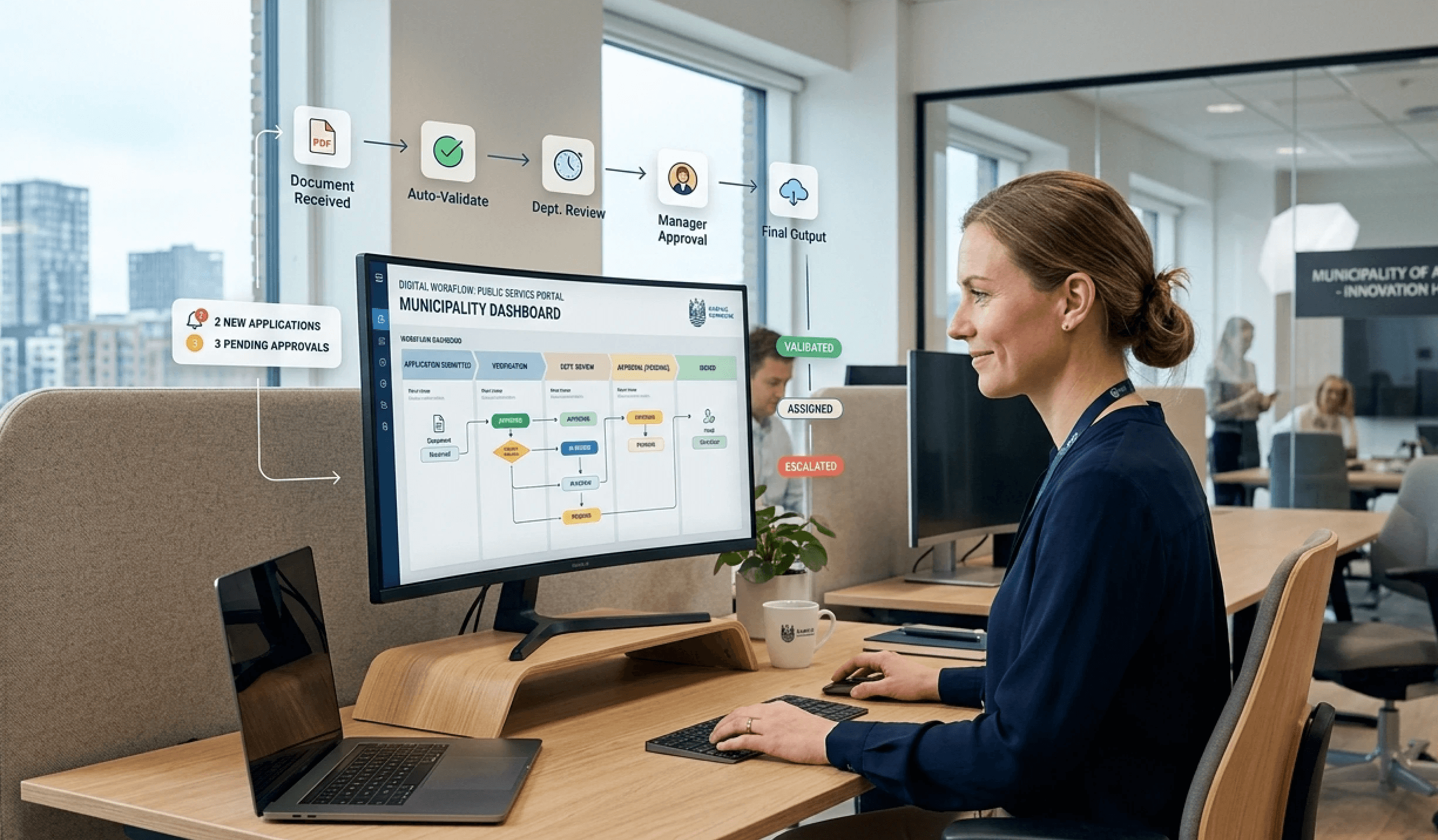
This is also why many municipal environments benefit more from tidying up channels and responsibilities than from buying yet another system first. If the employee knows where the information is, who owns it, and when it is relevant, much of the friction disappears. Here, it makes good sense to work with a unified platform for internal communication and task overview, such as a municipal intranet, which can support the practical work in health and care.
From noise to signal with a prioritised information ladder
The most useful model in a busy daily routine is often the one that is simple enough to be used consistently. A prioritised information ladder can be built around three levels that fit into what the team already has to deal with.
Red: Critical information that requires immediate action. This could be a sudden change in condition, a medication error, or an urgent need for follow-up.
Amber: Important information that must be read during the shift. This could be an observation, a change in functional ability, or a message that requires planning later in the day.
Green: For information purposes, which can be gathered and shared more broadly. This could be general reminders, updates, or news that do not require an immediate reaction.
The method works best when the team agrees on one common practice for each colour. Red, for example, must always be visible in the channel checked first. Amber must be easy to find, but not disrupt urgent tasks. Green should accumulate in one place so that it does not get drowned in daily messages. The crucial thing is that not everything ends up as red, because then the colours lose their value.
A good starting point is to test the ladder at the next board meeting and adjust according to what is actually used. Colibo's article on internal communication during change can be used as a background if management needs a common language for the change.
Modern intranets and mobile as the information highway
Information must follow the employee
Many in the health and care sector do not work at a fixed PC. They move between citizens, document on the go, and only have short windows to read updates. Therefore, the information must follow the employee, not the other way around.
A modern intranet must, first and foremost, do three things. It must gather news and operational messages in one place, make it quick to find the right content, and make it possible to receive the message on a mobile phone when it is relevant. If the platform requires the employee to sit down in front of a desktop screen to get an overview, it misses the reality.
Structure before more features
A good intranet in 2026 should be built around a few, clear spaces. A news feed, team pages, policies, instructions, and a searchable knowledge base are often enough to begin with. When content is tagged consistently, it becomes much easier to find, and the employee avoids having to search through emails, folders, and messages back and forth.
Mobile access is not an extra feature, but a requirement. Push notifications can be used for things that are truly urgent, while info screens can handle short operational announcements and practical messages that need to be seen by many. This makes the choice of channel more precise and reduces noise.
A simple way to evaluate a platform is to ask if it can answer these four things:
Can the employee get the message on their mobile without having to return to a PC?
Can management target notifications so that not everything hits everyone?
Can vital knowledge be searched for quickly, even when the phrasing is not completely precise?
Can content be managed by role and task, so that a nurse, a social and health care assistant, and a manager do not see the same thing first?
AI search must shorten the path to answers
A built-in AI search can be useful when based on the organisation's own data and used to find answers in internal guidelines, policies, and historical content. The strongest effect comes not from being clever, but from saving time on repetitive questions that would otherwise end up in email chains or phone calls.
Practical point: AI is only useful if it points to material that is already approved and maintained. It must not become a new source of doubt.
This is also where data sovereignty matters in practice. In the health and care sector, hosting, operations, and security should be clarified so that the organisation can keep track of where data resides and how access is controlled. A solution like Colibo's mobile app illustrates the type of access where the employee can get news, messages, and content on the go without disrupting their workflow.
ISBAR, board meetings, and interruption-free handover
Verbal handover requires fixed frameworks
Verbal communication is still one of the most important channels in daily life, but also the most vulnerable. This is where misunderstandings, half-heard messages, and interruptions most quickly have consequences. Therefore, Danish patient safety materials recommend standardised communication such as Write down and read back for telephone prescriptions, ISBAR for verbal messages, and mandatory electronic health record logging of all healthcare tasks, including time, responsible employee, and relevant observations, as described in the Danish Nurses Organization's professional material.
The crucial point is that the verbal message does not stand alone. Once someone has said it aloud, it must also be written somewhere where the next person can see it, and where responsibility and follow-up are clear. Otherwise, there is too great a risk that vital information slips away between two shifts.
A brief board meeting works when it is structured
A 5-minute board meeting at shift handover can gather information without dragging out. The most effective format is short and predictable, where the team follows a fixed order: first red, then amber, and finally green info updates, if time permits.
A practical meeting structure might look like this:
Acute red matters first. What requires action now, and who will take it?
Amber follow-ups next. What needs to be kept an eye on during the shift?
Green info updates last. Which messages just need to be noted and shared further?
What makes the meeting useful is not its length, but its discipline. No long explanations, no side tracks, and no hidden messages in passing. When someone takes responsibility, the name, time, and observation must be written down immediately.
Agreement that works in practice: If a message cannot be retold by another employee after the meeting, it has not been communicated well enough.
Combined use reduces loss
Verbal handover alone is too fragile. Written documentation alone is too slow if it is not organised. The combination of ISBAR, board meetings, and clear record-keeping practices offers the best chance that information is both understood now and can be found later.
This is also where more teams discover that the greatest gain lies in consistency. When everyone knows that important messages always start in the same place, the shift handover becomes calmer, and fewer things fall through the cracks. It is not more paperwork; it is a way to avoid duplication of work.
Relatives and citizens as part of the information cycle
When they do not get answers, they create their own picture
If information only circulates internally, a vacuum quickly arises. Relatives call again, the citizen becomes anxious, and the employee must spend time explaining the same thing multiple times. The best antidote is not more text, but clearer access to the right level of information.
The Danish Health Authority's material on relatives emphasises that information must be concrete, verbally anchored, adapted to the recipient's needs, and based on consent and clear expectation management, as detailed in the handbook for relatives. This means that relatives should not have the entire medical record. They should have the part that helps them understand the process and their own role.
The short format works best
A busy social and health care assistant does not need a long explanation to provide qualified information. A fixed, short phrasing can make the work more reassuring for both staff and relatives.
What has changed: The sentence should start with the concrete detail, not with a long introduction.
What it means now: Explain if there is anything to keep an eye on today.
What the staff is doing: Provide one clear expectation for follow-up or contact.
This is also where digital channels can be used thoughtfully. A brief message in a consent-based group for relatives, a shared update, or a fixed expectation agreement upon moving in can take the pressure off the phone lines without adding more work to frontline staff.
If a practical framework around home care and support for the elderly is needed, a solution like home care services for the elderly at Eva's Home Service can be a relevant example of how the needs of relatives and daily safety can be considered together without interfering with professional documentation.
A week of better information flow: Your starting plan
Monday to Friday without major upheavals
The fastest path to improvement is to start small and stick to it. A team leader, an occupational health and safety representative, or a super-user can achieve a lot in a week if the flow of information is first made visible and then tightened up in practice.
Monday: Map the three most painful information losses. These could be messages that arrive too late, messages that are repeated over and over, and messages that no one can find afterwards. Spend 15 to 20 minutes and write them down in the team's own words so everyone recognises the issues.
Tuesday: Introduce red, amber, and green at the board meeting. Start with a few examples so everyone knows what belongs in each category. Keep the meeting short and do not let it drag out into all sorts of other matters that do not affect the next shift.
Wednesday: Clean up the intranet and noticeboards. Remove duplicates, old messages, and content without an owner. Make it clear where the current version is located, so the employee does not have to spend time searching for the correct information in the middle of their work.
Thursday: Test mobile notifications and any AI search on a small sample of content. The crucial thing is not advanced features, but whether the employee can actually find the answers in time when their phone or screen is what they have at hand.
Friday: Briefly evaluate at the team meeting. What became easier, what was overlooked, and which messages should use a different channel next week? This conversation offers the most value if it is concrete and close to the daily routine where messages are either used or lost.
The checklist that makes the difference
In the beginning, keeping an eye on four things is enough.
Are messages clearly prioritised?
Does everyone know who owns the follow-up?
Can the information be found again without extra hunting?
Does the channel fit the task and the person who needs to use it?
When it works, it must become a habit and not a special project. Good information practices only last if the next shift also carries them forward. Therefore, experiences must be handed over directly between shifts so the system does not become dependent on a single passionate individual who alone holds everything together.
If the municipality or care organisation wants a more unified approach to internal communication, mobile access, and searchable knowledge, Colibo can be used as a platform to gather messages, work tools, and internal answers in one place. This is particularly relevant when information needs to get through in a busy working day where employees do not sit in front of a PC all day. Get in touch with Colibo and see how this type of intranet can support your information flow in practice.