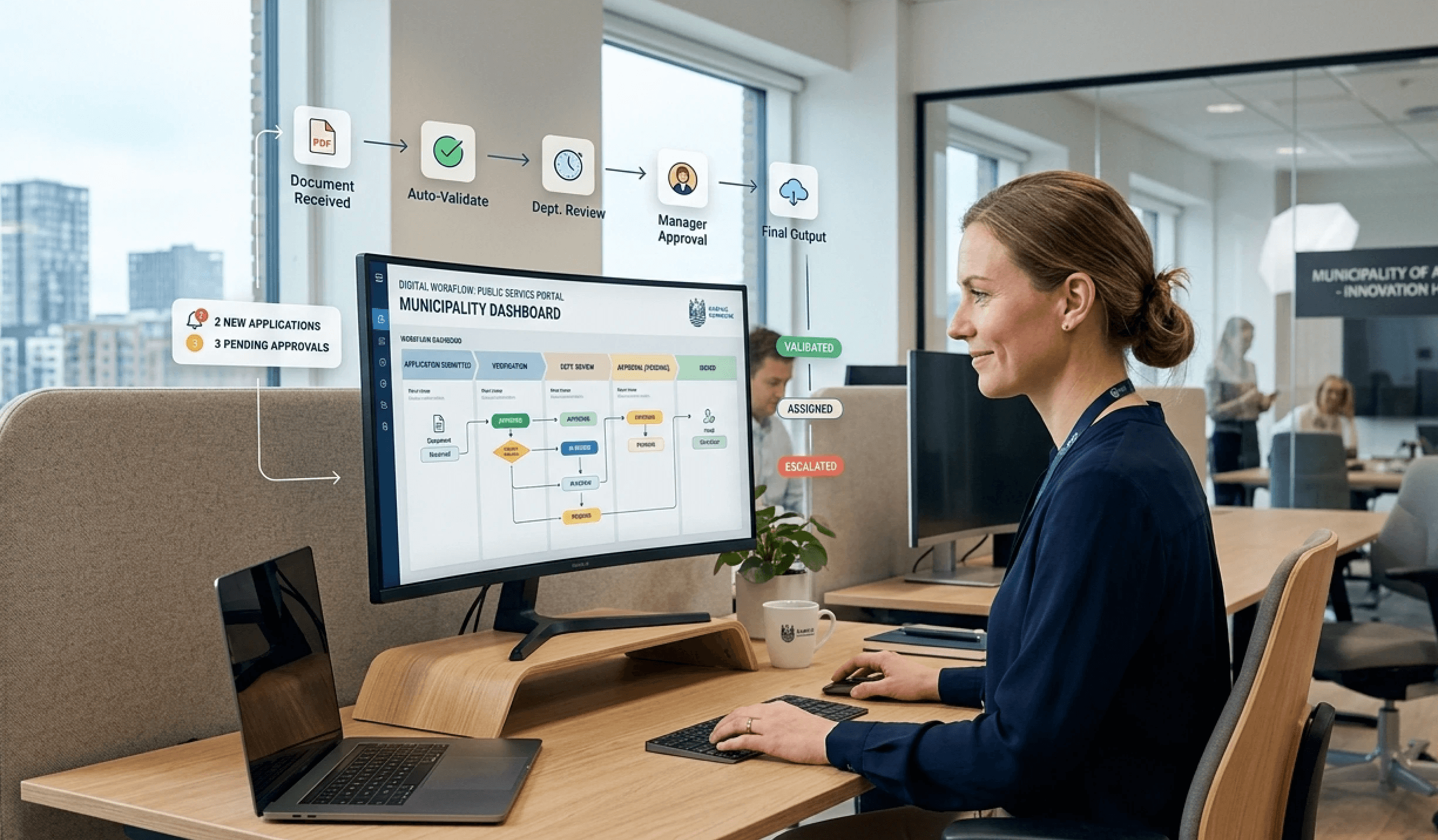


How a logistics company can unite operations, HR, and news in one place

Monday morning starts with a familiar pattern in many logistics companies. A driver is missing the latest procedure. A terminal manager sends an important operational message out in a local channel. HR has updated a policy elsewhere. A middle manager receives three phone calls about something that should already be available to everyone.
It often looks like a communication problem. In practice, it is a structural problem.
When operations, HR, and news are scattered across email, folders, local notices, professional systems, and oral handovers, almost always the same five consequences arise. Employees do not know where to look. Important messages do not reach everyone at the same time. Multiple versions of the same document appear. Management lacks an overview of whether something has actually been seen. And frontline employees become dependent on what a manager or colleague happened to say in passing.
In Danish logistics, this is not a peculiarity. It is a predictable consequence of an industry with many teams, locations, and shifts. At the same time, as also described in this perspective on logistics and employee communication, it is an under-examined question of how a logistics company consolidates operational messages, HR tasks, and news without creating more information noise about information needs in Danish logistics.
For companies working with transport and logistics in a unified digital workspace, the challenge is therefore not just getting yet another system. The challenge is to create one place where employees instinctively know to go first.
Introduction: Do you recognise information chaos in operations
The time is 05:40 at the terminal. A team clocks in to a changed procedure that only half of them have seen. A driver calls the dispatcher to confirm the latest instruction. At the same time, HR has sent important information about absence and safety in another system that the frontline rarely opens. Operations continue, but with minor stops, extra questions, and different interpretations of the same message.
In logistics, I rarely see information chaos arise from a single bad decision. It arises because, over time, the company has layered new tools on top of old habits. Each solution made sense locally. Combined, they yielded more search time, more interruptions, and greater dependency on key people who know where the information is hidden.
Five signs that operations have become digitally fragmented
The same patterns recur in transport, warehousing, and terminal operations.
Unclear gateway to knowledge means that employees turn to their nearest manager or colleague first, because the answer could lie in an email, Teams, an HR system, a folder, or a local document.
Asynchronous message dissemination means that one location acts on a change immediately, while another continues with the old practice until the next shift.
Document version clutter occurs when procedures, risk assessment (APV) material, onboarding, and staff info exist as attachments, printouts, and local copies.
Lack of readership overview makes follow-up uncertain. Management can send an important message without knowing whether it has actually reached the relevant employees.
Oral dependency becomes the standard for employees without a fixed PC, especially drivers, warehouse teams, and terminal staff.
The last point often costs more than you think. Oral handovers are quick within an individual shift. But when the same message needs to be understood uniformly across 10 locations, oral communication quickly turns into 10 local interpretations.
When employees have to guess where information lives, different realities emerge within the same company.
Why the problem is more prominent in logistics
The consequence is greater in logistics than in many office environments. Here, everyday life depends on timing, shifts, many role types, and precise execution close to the customer. If information about safety, changed procedures, or staffing goes awry, it does not just manifest as annoyance. It shows up as errors, waiting time, extra calls, and unnecessary escalations.
I have seen the same pattern in companies that succeed in clearing up the clutter. They do not start with more channels. They start by deciding where the frontline should actually go to find operational messages, HR information, and shared news. For logistics companies wanting to bring that part of everyday life together better, a digital workplace for logistics and transport is often the first practical step.
The classic mistake is still to add yet another layer. More Teams groups, more emails, more local notice boards. Then the noise simply moves address. The problem does not get any smaller.
What is a unified platform for operations, HR, and news
A unified platform is not just an intranet in the old-fashioned sense. It functions better as a digital headquarters. One place where employees find operational messages, HR tasks, documents, local information, and shared news without switching between a handful of systems.
Historically, this makes good sense. HR in modern organisations typically consolidates employee data, time, payroll, and onboarding into one solution. In logistics, the same data can be used across rotas, staffing, and communication, supporting the transition from siloed functions to a single digital workspace, as detailed in SAP's description of HRMS.
What the platform needs to do in practice
The crucial thing is not whether the platform has many features. The crucial thing is whether it reduces shifts, doubt, and duplicate work.
A useful platform should, as a minimum, handle these needs:
Everyday need | What the platform must solve |
|---|---|
Operational changes | Targeted messages to relevant teams and locations |
HR information | A single source for policies, onboarding, and staff information |
Document management | One single valid version of procedures and guidelines |
Frontline access | Mobile access without heavy navigation |
Search | A quick path to answers without needing help from a manager or colleague |
This is why an intranet as a digital workplace is relevant, when the goal is not just internal communication, but a shared gateway to the working day.
What works and what doesn't
What works is a simple division between the urgent, the useful, and the shared. With a few clicks, the employee should be able to distinguish between:
Operations right now which affect the day's work
HR and self-service which require action or lookup
News and leadership communication which create direction and cohesion
What does not work is putting everything into the same news feed. When safety, local route changes, anniversaries, onboarding material, and the CEO's update look visually and structurally identical, the employee loses the sense of priority.
Practical rule: A unified platform must make it easier to ignore the irrelevant and quicker to find the important.
The measurable benefits of consolidating internal communication
When a logistics company consolidates internal communication, the biggest benefit is rarely "better information" in an abstract sense. The benefit shows up in the working day. Employees find answers faster. Managers get fewer repeat questions. Documents become easier to trust. And the organisation gets a clearer picture of whether critical information has actually reached people.
Danish analyses indicate that HR creates the greatest value when the function is strategic and data-driven. In logistics, workforce management and internal communication are increasingly perceived as business-critical management information. When HR data, operational data, and communication are brought together, the capacity for decision-making and the ability to react to disruptions is strengthened, as explored in this Danish analysis of HR's value creation.
What companies typically notice first
The first improvements are often very concrete.
Faster access to information means that employees spend less time searching for procedures, messages, and documents.
Fewer repeat questions relieve managers, HR, and operations, because more people can find answers themselves.
Better mobile reach makes it easier to reach employees without a fixed PC.
More consistent document usage reduces local versions and duplicate documentation.
Greater precision in targeting increases the chance that the individual actually reads what is relevant.
This is precisely where the business case becomes strong. Not because everything becomes perfect. But because less friction in a busy operation quickly becomes noticeable.
KPIs that make sense in a logistics company
Many measure too broadly and end up with fancy dashboards that nobody uses. A better approach is to track a few indicators that relate to the real working day.
Relevant KPIs can include:
Active users to see if the platform is actually becoming a first choice
Read rates on important messages to assess reach and relevance
Mobile usage to understand frontline adoption
Searches and document views to see if employees are finding answers themselves
Fewer repeat inquiries to managers, HR, and operations
Qualitative feedback from employees and local managers
An important detail is that read rates alone are not enough. If everyone receives everything, the figure becomes less valuable. Targeted messages create a better signal because relevance and reception are more closely linked.
High activity on the platform is not a goal in itself. What is interesting is whether fewer people have to ask around to get on with their work.
The benefit that management often overlooks
The most underestimated benefit is consistency. When employees work from the same daily information, the need for local shortcuts falls. This makes everyday operations more resilient, especially when changes occur in operations, staffing, or safety procedures.
This is also where internal communication goes from being a support function to a management tool. Not as communication rhetoric, but as an operational discipline.
Implementation Guide: From silos to a shared platform
A successful implementation rarely starts with technology. It starts with ownership. If the project is placed solely within HR, the solution often becomes too staff-oriented. If operations alone own it, the shared employee communication becomes too narrow. The strongest approach is a joint setup involving operations, HR, communication, IT, and management.
The HR element should be treated as an HRIS with cloud integrations. Modern cloud-based HR systems centralise employee data, payroll, and absence, and improve data accuracy and decision-making power. The same benefit can be exploited in logistics by linking HR data to rotas and staffing needs, giving managers a single unified operational overview, as explained in SAP's explanation of HRIS.
Step 1: Assemble the right project team
The project team must reflect everyday reality.
Operations must be able to represent routes, terminals, warehousing, safety procedures, and local messages. HR must own employee information, onboarding, working environment, policies, and absence-related content. Communication must ensure structure, tone, and cohesion. IT must know the integration landscape. Management must set the direction and mandate.
This is also where many underestimate the role of middle managers. If local managers do not feel involved early on, they later become either a bottleneck or a point of resistance.
Step 2: Map needs before moving content
It is tempting to start with existing folders and old news. That rarely yields a good result. First, the company must map which types of information employees actually use in their daily routine.
A simple working model is to sort everything into three tracks:
Track | Typical content | Primary target audience |
|---|---|---|
Operations | Procedures, safety, route changes, local messages | Frontline and managers |
HR | Handbook, onboarding, policies, absence, staff matters | All employees |
News | Shared updates, leadership communication, culture | The entire organisation or selected groups |
This sorting makes it easier to define target audiences, push rules, and content ownership.
Step 3: Agree on who owns what
Without clear ownership, the new platform will quickly become just as cluttered as the old one.
There should be answers to these questions:
Who approves operationally critical messages
Who updates HR documents
Who removes outdated content
Who decides if a message should go to everyone or only to specific teams
Who follows up if important information is not being read
It is better to have a few clear content owners than many contributors without responsibility.
Step 4: Build simple and mobile-friendly
Frontline employees will not accept complicated navigation. For instance, if a driver has to stand and scroll through menu items to find a procedure, the platform loses its efficacy.
Therefore, the structure should be short, recognisable, and clear on mobile. Many companies find great success by clearly distinguishing between operations, HR, news, documents, and local information right on the homepage.
For organisations working with change in practice, it can also be useful to align implementation with classic change models in organisational development, especially when both workflows and habits need to be shifted at the same time.
Step 5: Test with real users and launch through leadership
Pilot groups should not consist only of administrative staff. The test must include drivers, warehouse teams, terminal staff, and managers from operations. They see different problems. Especially navigation, mobile usage, and wording are often put to the test here.
The launch itself should be driven by line managers and local key individuals, not just by the project team. When the platform is introduced as a part of daily operations rather than as a side project, the chances of adoption increase.
The technology behind: Integrations, security, and data sovereignty
Once the platform is decided, the question arises that many organisations address too late: what should actually be integrated, and what should simply be easily accessible?
This is an important distinction. Many integration projects become heavier than necessary because the company attempts to consolidate everything technically into one place. In practice, it often delivers more value to make the platform the shared starting point, while heavy transactions continue to reside in the original core systems.
Integrations that typically offer the most value
In a logistics company, there are some integrations that consistently prove particularly useful:
Microsoft 365 because documents, Teams, Outlook, and collaborative spaces are often already part of the working day
ERP or SAP when employees need quick access to order information, processes, approvals, or operational data
Document management so the valid version of procedures and instructions is easy to find
Single sign-on because extra logins almost always hinder adoption
The most important principle is simple. Integrations must be prioritised based on business value, not technical fascination.
A good rule of thumb is to start with whatever solves a concrete everyday problem: easy access to documents, fewer logins, better search, a quicker path to the systems employees already use.
Data basis and unified overview
In more mature setups, the technically strong architecture often involves consolidating ERP, TMS, warehouse management, GPS, and financial systems into a single data layer. This makes it possible to work with real-time dashboards for management, operations, and customer service, as well as forecasts for routes, staff, and inventory, as described in this industry perspective on transport and logistics by Cognitech.
This does not mean everything should be shown to everyone. On the contrary. A shared data layer is most valuable when the platform also manages role-based access sensibly.
Security and data sovereignty are not secondary requirements
In logistics with Danish operations but international IT infrastructure, compliance and data sovereignty are often the overlooked parts of the project. Many sources explain integration possibilities, but far fewer go deep enough into personal data, role-based access, and hosting choice. This is particularly relevant for companies wanting to minimise dependency on US platforms and have verifiable control over data, as noted in this perspective on all-in-one HR platforms and the overlooked considerations.
This translates into three practical requirements:
Role-based access so that drivers, terminal managers, HR, and administration do not see the same things
Clear hosting choice so the company knows where data is stored and how it is managed
Verifiable governance so it is clear who has access to what and why
Frontline employees will accept security if it is simple. They rarely accept extra complexity without clear utility.
That is why security and user-friendliness must be designed simultaneously, not as two separate tracks.
Conclusion: Your next action towards a unified working day
Bringing operations, HR, and news together in one place is not about buying yet another channel. It is about making the working day more coherent for people who otherwise have to navigate shifts, locations, deadlines, and local interpretations.
When a logistics company succeeds in doing this, not all complexity disappears. But the complexity gets organised. Employees know where to go first. Managers spend less time repeating the same things. Documents get a clear owner. And important messages become less dependent on oral chains of communication.
The decisive move is rarely first technical; it is organisational. Operations, HR, communication, IT, and management must build a shared model for what is critical, what is useful, and what is shared. Only then does the platform deliver its full value.
The most logical next step is highly practical. Call a brief working meeting with operations, HR, and communication. Map all the places where employees currently find information. Write them down. Then mark three things: what is operationally critical, what is HR-related, and what is shared news.
If the map looks messy, that is not a defeat. It is the beginning of a better structure.
A company looking to consolidate internal communication, knowledge, and daily work tools into a single solution can take a closer look at Colibo. The platform can be used as a standalone intranet or integrated with existing environments, and is highly relevant for organisations working with mobile access, data sovereignty, and a more unified digital working day.