

Management of change models: Choose the right one in 2026

That situation is recognisable in many Danish organisations right now. A new platform has been chosen. Executive management expects progress. The project group has created a plan, timeline and governance. But after go-live, the same problems arise again: employees use old workflows, middle managers translate the change differently, and support is drowned in questions that really should have been resolved before launch.
This is precisely where management of change models become useful. Not as theory for theory's sake, but as a practical way to manage behaviour, leadership, communication and anchoring in organisations where operations, compliance and professional quality must not break down along the way. For a municipality, a hospital or a utility company, the question is rarely whether change should happen. The question is how it is implemented without creating more friction than progress.
A good model makes one thing clear: technical implementation is not the same as organisational adoption. It is the difference between having rolled something out and having made it work in everyday life.
Why most changes fail and how to avoid it
Many changes do not fail because the strategy is wrong. They fail because the organisation underestimates the work that lies between the decision and lasting behavioural change. Systems are bought, business cases are prepared and deadlines are set. But no one actually builds a bridge between management intention and the employees' everyday life.
An often-cited report states that 70% of change initiatives fail, and the same overview points out that the most widely used frameworks are Kotter's 8-Step Model, ADKAR and Lewin's Change Model, precisely because organisations need structure around communication, involvement, training and anchoring (overview of change management statistics).

What typically goes wrong
In regulated environments, the same patterns are seen again and again:
The change is treated as an IT project. The solution goes live, but ownership is lacking in the line business.
Communication becomes too general. Employees hear that something new is coming, but not what it means for their specific workflows.
Middle managers become a bottleneck. They are expected to drive behavioural change but are given neither the language, time nor tools to do so.
The criterion for success is set too low. Go-live is mistakenly equated with success.
Practical rule: If an organisation only measures whether the solution is implemented, it measures activity. Not change.
What actually works
What works is rarely dramatic. It is disciplined. A usable model forces the organisation to answer the questions that are otherwise skipped over: Who will be affected? Where will resistance arise? Which leaders need to be visible? What needs to be different in daily operations three months after launch?
For a public sector leader, the point is simple. A change model does not reduce complexity by ignoring it. It reduces complexity by structuring it. That is why management of change models are not just academic frameworks, but management tools for organisations where errors affect citizens, patients, operations or compliance.
What is a change model and why use one
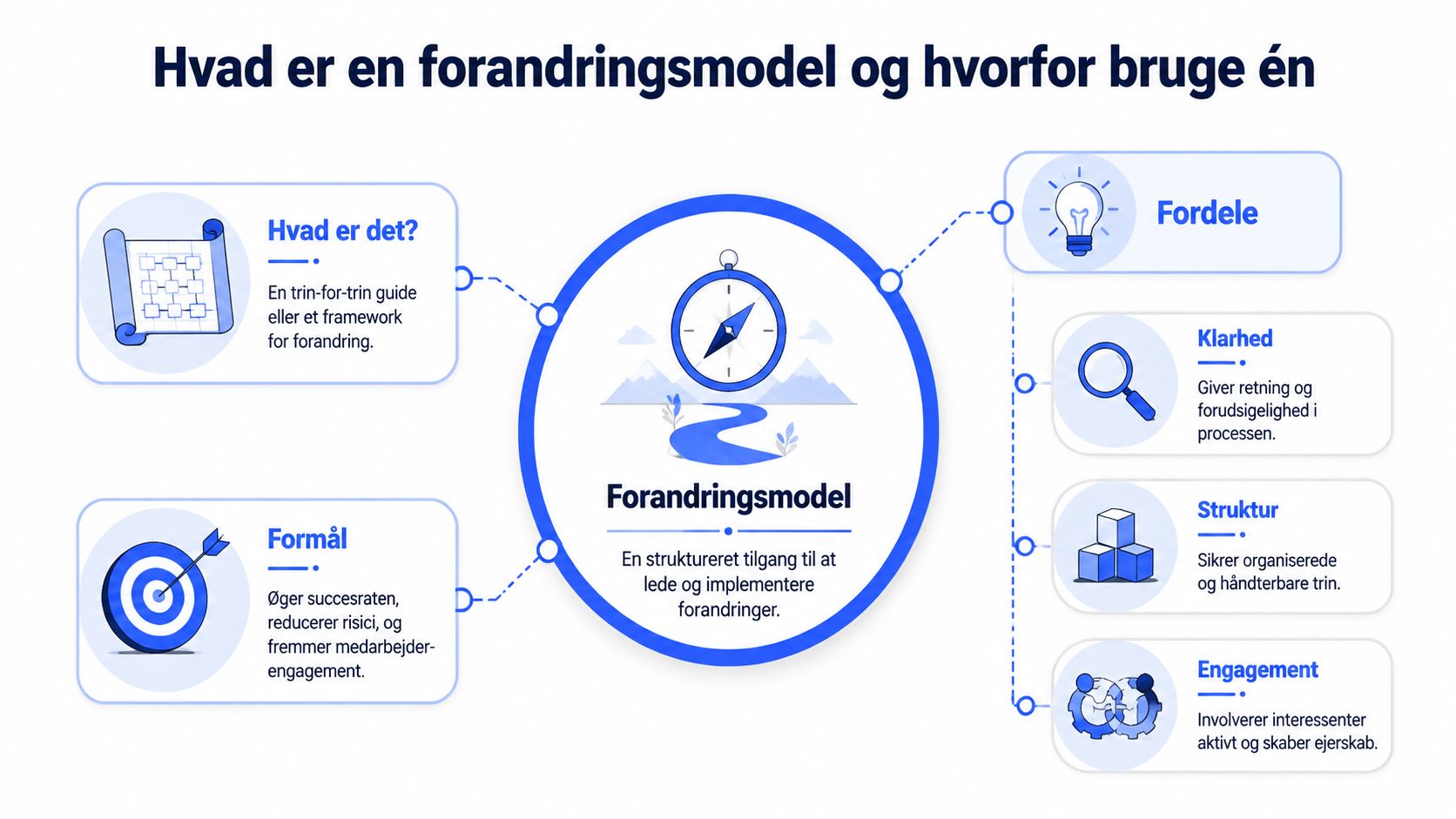
A change model is a structured way to implement organisational change. It functions as a roadmap that makes it clear what needs to happen before, during and after implementation. It sounds basic, but in practice, it is crucial. Without a model, change is easily reduced to meetings, emails and hope.
The classic starting point is still Kurt Lewin's three-stage model: Unfreeze, Change, Refreeze. In modern change management, it is described as a key reference because it made organisational change manageable as a sequence of preparation, implementation and stabilisation. At the same time, it shifted focus from individual projects to the institutionalisation of new ways of working (Prosci on change management models).
Why the model matters in practice
In Danish organisations with strong operational demands, Lewin's basic idea still fits surprisingly well. First, the organisation must unfreeze old patterns. Then, the new behaviour must be introduced. Finally, it must be turned into normal operation. It is simple. And for that very reason, it is powerful.
A model also provides a common language. Project management, HR, department heads, IT and executive management rarely speak the exact same language about change. A shared framework makes it easier to determine whether the problem is a lack of direction, missing competence, weak leadership support or insufficient anchoring.
What a model prevents
When an organisation fails to use a model, three types of errors often occur:
Sequence errors. Training comes before employees understand why the change is necessary.
Lack of clarity on responsibility. The project group thinks the line business is taking over. The line business thinks the project still owns the task.
Relapse. The new solution is used briefly, but old routines return.
A good change model does not replace leadership. It makes leadership more precise.
This is also why later models like ADKAR and Kotter remain relevant. They build on the same core insight: change only succeeds when new behaviour becomes stable operation.
The 3 most popular management of change models
There are many models, but three recur in practice: Kotter, ADKAR and Lewin. They are often used for different types of challenges. Not because one is always better than the other, but because they approach change from different levels.
Some leaders choose incorrectly because they look for the most famous model. That is rarely the right approach. The better question is: Does the organisation primarily need to create direction, change individual behaviour or guide an entire process securely through daily operations?
Comparison of change models
Criterion | Kotter's 8 steps | ADKAR | Lewin's model |
|---|---|---|---|
Primary focus | Organisation and leadership | Individual and adoption | Overall process |
Typical strength | Creates direction, coalition and momentum | Makes resistance and learning manageable close to the employee | Creates a simple structure in complex processes |
Best suited for | Major organisational shifts | Implementations where behaviour and competence are critical | Changes with a need for stabilisation in operations |
Risk of incorrect use | Becomes too top-down | Becomes too narrow if leadership is not active | Becomes too course-grained without supplementary practice |
Leadership demands | High sponsor activity | Close leadership support in day-to-day work | Clear management of phase transitions |
Kotter when direction and leadership push are key
Kotter's model is strong when the organisation lacks overall direction. It is often used for major transformations, mergers, reorganisations or situations where leadership needs to create a shared understanding across silos.
The core of the model is not the individual steps in isolation. The core is that leadership must actively create urgency, assemble a guiding coalition, define a clear direction and maintain momentum until the change is anchored. This works well when the issue is political, organisational or cultural.
It works less well if the organisation believes that a strong vision automatically creates local adoption. It rarely does. The front line still needs support, training and follow-up.
ADKAR when adoption happens one employee at a time
ADKAR is practical because it focuses on the individual's transition. The model works with five building blocks: Awareness, Desire, Knowledge, Ability and Reinforcement. It is particularly useful when management knows exactly what needs to happen, but the organisation struggles to get employees to actually change their behaviour.
This is typically relevant for new workflows, new systems, documentation requirements, service processes or cross-cutting standardisation. Here, ADKAR helps to distinguish between different types of resistance. Does the employee lack understanding, motivation, knowledge, practical ability or sustained support? These are not the same problem, and they do not require the same solution.
When an employee does not use a new solution, the question is not only whether the person wants to. It is also whether the person can, understands and is followed up on.
ADKAR is less suitable as the sole framework in very large organisational shifts if senior and middle management are not simultaneously working consciously with governance, coalition and structural barriers.
Lewin when stable operations and anchoring are at the center
Lewin's model is the simplest of the three, but that does not mean basic. It is strong in environments where change must be carried out without weakening operations, quality or compliance. This often applies to municipalities, hospitals and critical infrastructure.
Unfreeze is about making it legitimate to change something. Here, the organisation works with argumentation, leader support and demonstrating why current practice is not sufficient.
Change is the implementation. New processes, tools, roles and workflows are introduced while leadership manages uncertainty and variation in adoption.
Refreeze is the phase that many skip too quickly. This is where new routines must be embedded into daily operations, governance, training and follow-up. Without this phase, the organisation often relapses.
Lewin is especially useful as an overall framework. In practice, many organisations combine it with more detailed tactics from ADKAR or Kotter. This is often the most realistic solution in complex environments.
Model match to your organisation Municipality Hospital Utility
The right model depends less on the name of the sector than on the type of change the sector is facing. Nevertheless, there are some recurring patterns. Public organisations rarely work with change in a vacuum. They work with professionalism, operations, political considerations, compliance and varying degrees of digital maturity at the same time.
Municipality
A municipality often faces changes that cross departments, professional areas and locations. This could be a new internal communication structure, a shared intranet, changed visitation workflows or pooling knowledge in one place. Here, the challenge often arises in coordination, not just in the technology.
For major cross-cutting changes, Kotter is often a good fit because the municipality needs a clear guiding coalition and a shared narrative that can hold different professional logics together. If the social area, HR and the technical and environmental area need to work more uniformly, it requires more than local super users. It requires leadership direction.
For municipal environments with many stakeholders, it can be useful to look at how digital solutions are used in municipalities and public organisations, especially when internal communication, process support and knowledge sharing need to connect.
Hospital
In a hospital, changes are rarely just a matter of new systems or new workflows. Here, implementation is closely linked to patient safety, documentation, quality and an everyday life where employees often work under time pressure.
Therefore, it is rarely enough to communicate a strong vision from the top. If a change affects clinical daily life, the individual employee must be able to understand, accept and use the change correctly in practice.
Here, ADKAR often fits well because the model focuses on adoption by the individual employee. A nurse, medical secretary or therapist should not just be informed about the change. They must have the right knowledge, training and support to use it safely in their daily work.
This requires targeted training, close leadership follow-up and local support close to the teams where the change is to take place. Hospitals rarely succeed with major changes if they overestimate information meetings and underestimate practical learning in everyday life.
Utility
In utility and infrastructure companies, changes often look different. Here, stable operations, documentation, high safety and clear processes are crucial, because even minor errors in information flow or workflows can have major consequences.
Therefore, change management in the utility sector is not just about getting employees on board with a new idea. It is also about ensuring that the organisation can change without losing control, operational reliability or a shared direction.
In this type of environment, Lewin's model can be a strong basic framework. It makes it clear when the organisation is ready to unfreeze old routines, when the actual change must be implemented, and when new workflows are anchored well enough to become a natural part of daily operations.
However, Lewin does not have to stand alone. Many utility companies can benefit from combining the model with ADKAR in the teams where new systems, procedures or documentation requirements require concrete competence building.
As an overall management logic, Lewin fits the utility area well because the model respects that operations cannot simply be put on pause while the organisation changes.
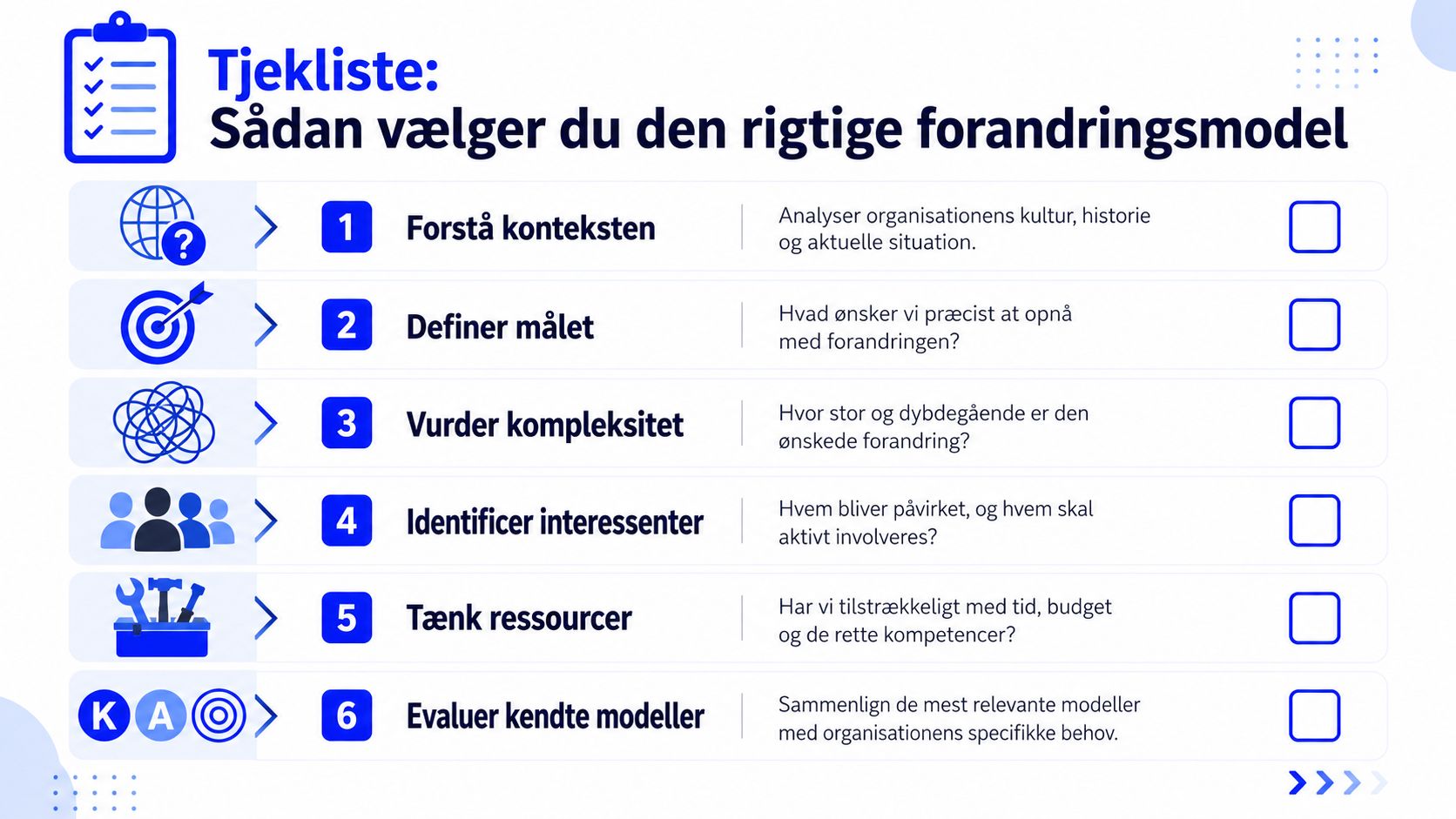
Checklist How to choose the right change model
The choice of model should not begin with preference. It should begin with diagnosis. Many organisations choose the model that the project manager knows best, or the one that an external partner uses most. This is an unnecessarily expensive shortcut.
Six questions that cut to the core
Start with these questions and use the answers to point to the most likely model.
Is the challenge primarily strategic or operational?
If the problem is about direction, leadership support and cross-cutting alignment, it often points towards Kotter. If the direction is already set but behaviour is not following, it points more often towards ADKAR.How close is the change to the employees' daily practice?
The more the change affects concrete workflows, the stronger the argument for a model with an individual focus.Can operations tolerate uncertainty along the way?
In environments with low margins for error, there is a need for clear phase transitions, stabilisation and anchoring. Here, Lewin often makes sense as a basic structure.
Is the resistance likely to be collective or individual?
Collective resistance often arises around prioritisation, politics or culture. Individual resistance is more often about understanding, motivation or competence. That distinction is important.How strong is the leadership chain in practice?
A model that requires high sponsor activity quickly falls flat if leadership is not visible and consistent. Do not choose a leadership-heavy model if leaders cannot realistically carry it.Should the model be simple to explain broadly?
In complex organisations, usability is more important than elegance. The best model is the one that leaders andkey people can actually apply consistently.
The right model is not the most complete on paper. It is the model the organisation can translate into behaviour.
A practical choice often looks like this: Kotter for large cross-cutting shifts. ADKAR for adoption-critical implementations. Lewin as an overall structure when stable operations and anchoring are most important. And in many cases, a combination, as long as it does not make management unnecessarily heavy.
From model to reality How to implement and measure success
The hardest work starts after the model is chosen. Many organisations believe they now have "the method in place". But a model does not create change on its own. It must be translated into responsibility, communication, learning paths, leadership behaviour and operational follow-up.
The practical mistake is often the same. The project creates a major implementation plan, but no one creates a corresponding plan for adoption. Consequently, governance is strong up to go-live and weak afterwards.
What should be measured in operations
To assess whether the change is actually working, Prosci recommends measuring speed of adoption, ultimate utilisation and proficiency. This is about how quickly employees start using the solution, how many are actually using it, and how well they apply it. These KPIs can be linked to concrete operational outcomes such as fewer support inquiries and faster case handling (Prosci on measuring change management).
This is a much more useful management picture than classic status measurements. A solution can be formally implemented and at the same time fail operationally. Therefore, leadership should monitor adoption at fixed intervals and adjust efforts continuously.
This is especially true in organisations where knowledge sharing, internal communication and daily workflows are closely connected. This link is well described in this article on knowledge sharing in organisations, because it shows why access to knowledge is part of the anchoring process and not just a support function.
How your intranet supports the change process
Classic models are still useful. But they say very little about the digital space where change actually plays out today. Employees do not meet the change in a framework. They meet it in the news flow, search, guides, messages from leadership, group dialogues and the tools they use every day.
Where classic models lack a digital layer
This is a real blind spot in the existing literature. A SITAG study from 2025 shows that 12% of public sector enterprises have a structured model for how AI affects change models. At the same time, a DANSKID report from 2026 shows that 74% of Danish hospitals and municipalities have chosen EU hosting to ensure compliance, but only 5% have a change model that integrates these restrictions. This points to a clear gap between classic models and modern organisational requirements.
This is particularly important in Danish organisations, where data sovereignty, EU hosting and audit requirements can affect both pace, choice of platform and communication setup. Standard models like Lewin and Kotter largely assume that the implementation environment is already clarified. Often, it is not.
From communication to adoption in one platform
A modern intranet can function as the operational layer behind the change model. Awareness can be supported through targeted news and leadership communication. Desire can be strengthened through local relevance, dialogue and visible wins in professional groups. Knowledge can reside in a structured knowledge base. Ability can be supported with guides, FAQs, support-friendly content and contextual help. Reinforcement requires follow-up, repetition and visible standards.
AI adds a new layer, but only if the organisation uses it with discipline. An AI assistant can help employees find answers within the organisation's own intranet data, thereby reducing friction in learning and daily use. But without a conscious change model, AI risks becoming just another tool that stands alongside work instead of supporting it.
This connection becomes clear when internal communication is treated as a part of the implementation itself and not as a side project. This point is elaborated in this article on the intranet's role in effective internal communication.
Colibo helps complex organisations gather internal communication, knowledge sharing and daily work tools into one modern intranet platform with the option of Danish/EU hosting, integrations and built-in AI based on the organisation's own data. For leaders who want to make change more manageable in day-to-day operations, it is worth taking a closer look at Colibo.