

Why internal communication is difficult in transport and logistics

When information is just as critical as delivery times, internal communication in transport and logistics becomes an operational matter, not just an HR matter. Employees work across offices, warehouses, terminals, depots and vehicles, often in shifts and without fixed access to a PC. This makes it difficult to ensure that the right message reaches the right employee at the right time.
This is precisely why the question of how we can optimise internal communication in transport companies is so relevant for management, HR, operations and IT. When information is scattered across emails, noticeboards, verbal messages and local documents, delays, misunderstandings and uncertainty about which version is valid easily arise. In the transport sector, practical experience and industry insights suggest that a mobile, central and uniform channel is crucial, particularly because work is often carried out away from the desk and across shifts and locations, as described in the industry guide on internal communication in transport and logistics.
This article goes straight to the measures that work in practice. The focus is on operations, safety, knowledge sharing and collaboration between the frontline and the office, so that internal communication in transport becomes more uniform, more targeted and easier to act upon.
1. A central, digital hub for real-time operational information
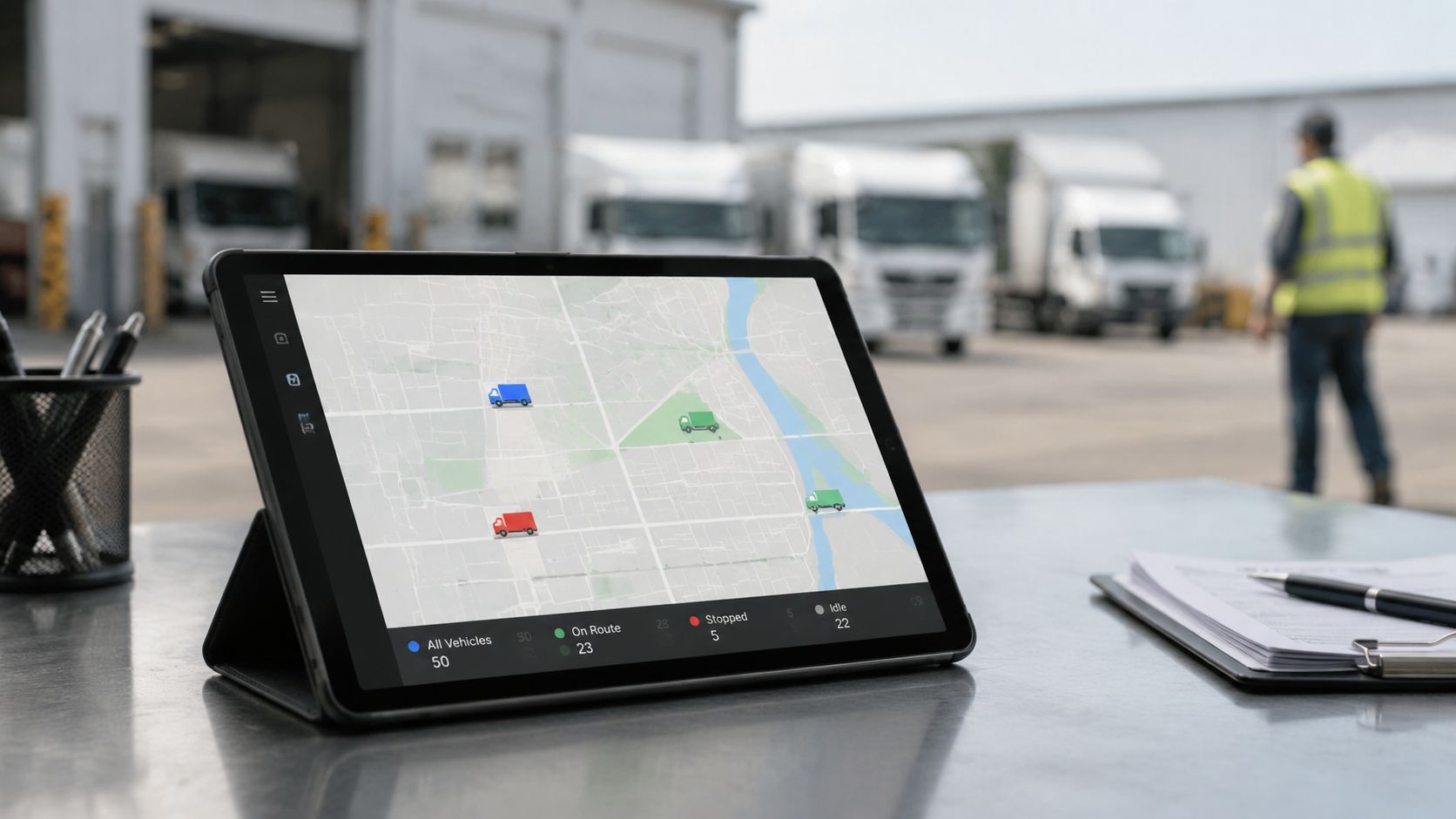
Transport companies do not just lose time due to a lack of communication. They lose oversight. When route changes are in one place, safety instructions in another and local procedures in a third, operations become dependent on who happens to know something.
A central intranet changes that logic. Instead of letting employees search through emails, call colleagues or rely on yesterday's printouts, operational-critical information is gathered in a single, shared environment. This applies to news, procedures, documents, operational announcements and local messages for specific teams.
When everyone looks in different places
A dispatcher changing a delivery schedule in the middle of the day needs a channel that is fast and uniform. A terminal manager needs to know that the night shift sees the same instruction as the day shift. A central digital hub makes this possible.
Practical rule: If employees have to ask "where is the latest version?", the communication structure is already too weak.
A modern intranet for internal communication and knowledge sharing should therefore function as the organisation's operational point of reference. Whatever is published there is what applies.
This works particularly well in transport because the work is geographically dispersed. At the same time, international practical examples show that effective solutions require facilitated shift handovers, digital boards and real-time channels in operational environments.
2. A mobile-first communication strategy for employees on the go

Email works best for employees at a desk. This makes it less suitable as a primary channel for drivers, terminal workers, warehouse teams and other deskless employees. In transport and logistics, mobile access must not be an afterthought. It must be the starting point.
This changes the requirements for the platform. Logging in must not be a hassle. The user interface must not require training to find the daily messages. Important updates must be quick to read between tasks, breaks or shifts.
Mobile access must be the primary experience
When dispatchers send targeted updates to a specific driver group or location, and employees receive them directly on their mobiles, collaboration becomes faster and more uniform. The same principle applies to operational disruptions, changed routes or urgent safety messages.
Mobile-first frontline communication works best when it is simple:
Push notifications for what is important so that time-sensitive messages do not get lost in general updates.
Direct access to documents so that drivers and warehouse teams can open the latest instruction without switching between multiple systems.
Targeted delivery so that a worker in the depot does not receive irrelevant messages from head office all day.
Many organisations find that mobile access closes the gap between the office and operations. A guide to mobile intranets for frontline internal communication is relevant because it shows how mobile channels can become the practical backbone of everyday work, not just an extra app alongside old workflows.
3. AI-driven knowledge sharing and self-service

In many transport companies, the same questions arise time and again. Which procedure applies in the event of an incident? Where is the updated checklist? Who should be contacted for changes in documentation? When answers can only be found with experienced colleagues or middle managers, it creates waiting times.
This is where AI-assisted self-service makes sense. Not as a replacement for management, but as a layer on top of the intranet's documents, policies, FAQs and procedures.
From questions in operations to answers in context
A mechanic in the workshop, a planner in administration and a new driver do not need the same information. They need quick access to answers based on their role and work situation. When an AI assistant works on the organisation's own intranet data, searching becomes more useful than a traditional document archive.
Quick knowledge sharing is rarely about more documents. It is about finding the right answer without disrupting operations.
However, this requires discipline. AI only helps if the content behind it is updated, sensibly named and owned by clearly accountable people. Otherwise, a chatbot just becomes a new route to old mistakes.
A solution like the Colibo AI chatbot for intranet data is relevant in transport and logistics because it can make procedures, guidelines and internal knowledge easier to find for both office employees and frontline workers. This is particularly valuable in organisations where the pace is fast and critical knowledge is often held by only a few people.
4. Collaboration channels and professional communities across roles
Many communication issues in transport are not caused by a lack of messages. They are caused by information flowing poorly between business functions. Drivers, mechanics, dispatchers, warehouse managers and customer service each see their own side of reality. If they do not have shared digital spaces, silos quickly form.
Collaboration channels make it easier to bring professional dialogue to where the work actually happens. This could be a space for depot managers, a forum for safety issues or a group for planning and operations during major operational changes.
Silos are not broken by sending more emails
A good digital community in transport is not a social wall with random posts. It is a structured collaborative interface where employees can share practices, clarify doubts and solve problems without having to start from scratch in each department.
It works best when groups have a clear purpose:
Functional groups for drivers, dispatchers or workshops with relevant updates and exchange of experience.
Cross-functional operational spaces for incidents, changes or improvement work across multiple locations.
Management spaces where middle managers can share standards for shift handovers, tone and local workflows.
North American sector experience points to digital screens, mobile devices and standardised templates for handovers as effective measures, alongside multiple channels, targeted delivery and training of frontline managers, as described in the KYTC report on communication in transport environments.
5. Multilingual communication and digital accessibility
Transport and logistics rarely operate with a single, homogenous employee group. There are different native languages, different levels of digital experience and different working conditions. Therefore, it is not enough to simply publish a message. It must also be understood and used.
This is particularly true for safety messages, procedures and changes in operations. If an employee is in doubt about the meaning, the communication is not complete, even if it has been sent out.
Understanding is more important than delivery
Multilingual communication is not just about translation. It is also about structure, clear headings, short paragraphs, consistent word choices and mobile access. In practice, the following works best:
Role-critical messages in simple form so employees can quickly see what has changed and what they need to do.
Fixed templates for operations and safety so content is presented consistently across teams and locations.
Accessible design so employees with different digital fluencies can navigate without assistance.
A message is only effective when the recipient can act on it without requiring interpretation from a middle manager.
This aspect is often overlooked in discussions about intranets for transport companies. But in an industry with operational pressure and diverse workforce groups, digital accessibility is a tangible operational tool, not just a communication ideal.
6. Safety-first communication and incident reporting systems
Safety information must not compete on equal terms with general news. In transport and logistics, critical messages must be able to break through quickly and reach the relevant employees, even when they are on the road or working shifts.
This applies to both acute alerts and more day-to-day safety communication. Instructions, incident follow-ups, changes in procedures and compliance requirements must be easy to find and clear to follow.
Critical messages must be able to break through
Many organisations focus too much on engagement and too little on communication during operational disruptions. But in transport, internal communication is also an operational tool. This is particularly true during delays, incidents and changed routes, when employees are not sitting at a PC all day, as highlighted in Axios HQ's advice on improving internal communication.
A safety-first setup should support three things:
Priority notifications for incidents and urgent matters.
A simple reporting path for near-misses and local observations.
Visible follow-up so employees can see that reporting leads to action.
A driver discovering a recurring loading problem, or a terminal worker noticing an unsafe workflow, needs to be able to report it without navigating through heavy systems. When incident reporting and safety communication are connected in the same digital workspace, it becomes easier to build a culture where errors are caught earlier and shared more openly.
7. Personalised onboarding and role-based learning
New employees in transport and logistics often face a complex day-to-day reality from day one. They need to know local routines, safety procedures, contact channels, documentation requirements and perhaps several different systems. If onboarding occurs via verbal handovers and scattered documents, quality becomes inconsistent.
A modern intranet can make onboarding more uniform and less dependent on who is on shift. This applies to drivers, terminal staff, planners and administrative employees alike.
Do you want to see how a modern intranet can support employees across the office, warehouse, terminal, operations and drivers? Read more on our industry page about intranets for logistics and transport, where we show how Colibo can gather internal communication, knowledge and operational information into a single shared platform.
New employees should not have to guess
Role-based learning means that employees see what is relevant to their function, location and responsibilities. A new warehouse worker should not have to go through the same information package as a dispatcher. A driver needs to be able to find procedures, contact persons and practical answers quickly from their mobile.
Value is created when onboarding is built around:
Role packages containing the most important documents, instructions and FAQs.
Location-specific content so employees see the rules and routines that apply where they actually work.
Continuous learning so that changes in procedures are not just introduced during hiring but are reinforced over time.
Organisations with multiple sites and shifting turnarounds benefit particularly from this approach. It reduces reliance on verbal explanations and makes knowledge sharing more stable. At the same time, it makes it easier for managers to ensure that everyone is working from the same foundation.
8. Two-way feedback and Employee Voice programmes
Communication in transport fails when it only moves from the top down. The frontline is often the first to notice when a procedure does not work, when a handover is unclear, or when a message does not match reality in the depot, at the terminal or on the route.
Therefore, two-way feedback is not a soft discipline. It is a practical method to improve operations, safety and workflows.
The frontline sees the problems first
A good feedback structure must be simple enough to be used in a busy workday. Employees must be able to ask questions, point out issues and suggest improvements without long flows or unclear ownership. This can be through comment sections on news, short pulse surveys, dedicated feedback channels or digital suggestion spaces.
When management only measures how many messages were sent, they are missing the most important insight: whether the messages were actually understood and applied.
Modern IC practice recommends measuring quality systematically through open rates, click-through rates, response rates, engagement and feedback loops, because otherwise communication easily becomes noise with no effect.
For decision-makers, this translates to something very tangible. If frontline communication does not provide a clear signal back to management, weak workflows are discovered too late.
9. Data sovereignty and a secure communication infrastructure
An intranet in transport and logistics rarely handles just news. It often houses procedures, employee information, operational messages, contact data and, in some cases, content with safety or compliance implications. Therefore, platform choice is also a question of governance, risk and control.
Many decision-makers look at features first. This is understandable, but insufficient. Hosting model, access control, integration options and a documented security foundation are just as important as the news feed and mobile app.
Platform choice is also a risk issue
A secure communication infrastructure should match the organisation's requirements, not the other way around. For some businesses, cloud hosting in the EU is the right choice. For others, on-premise solutions or tight control of data flows make more sense. The critical factor is that the communication platform can be incorporated into the overall compliance and operational model.
When evaluating a platform, the organisation should look in particular at:
Data sovereignty so the business knows where data is hosted and which regulations apply.
Permission management so that sensitive or local content is only seen by the relevant groups.
Secure operations and audit basis so the platform can support a maturity level that matches the organisation's risk profile.
For companies with many locations and diverse employee groups, this becomes the foundation of trust. Employees must be able to use the system with confidence, and management must know that internal communication in transport does not create unnecessary complexity or security risks.
9-point comparison: Internal communication in the transport industry
Solution | Implementation Complexity | Resource Requirements | Expected Results | Ideal Use Cases | Key Benefits |
|---|---|---|---|---|---|
A central, digital hub for real-time operational information | Medium to high (integrations) | IT integration, dashboards, training | Reduced silos; faster decision-making | Fleet and depot management, coordinated operations | Centralised info; real-time overview |
A mobile-first communication strategy for employees on the go | Low to medium (apps and offline) | Mobile development, push infrastructure, devices | Time-critical information delivered quickly | Drivers and frontline staff | Offline access; push notifications; simple UX |
AI-driven knowledge sharing and self-service | High (AI training and integration) | ML development, curated content, support | Fewer inquiries; faster answers | Maintenance, technical support, procedure lookup | Automated answers; scalable self-service |
Collaboration channels and professional communities across roles | Low to medium (setup and moderation) | Platform licences, moderators, cultural work | Increased knowledge sharing; better problem solving | Cross-functional teams, innovation initiatives | Breaks down silos; strengthens culture |
Multilingual communication and digital accessibility | Medium (localisation and WCAG access) | Translators, accessibility audits, localisation | Better understanding; fewer language-related errors | Multinational and diverse workforces | Inclusion; compliance with WCAG/GDPR principles |
Safety-first communication and incident reporting systems | Medium to high (workflow and alerts) | Reporting tool, analytics, training | Faster reporting; improved safety culture | Safety-critical operations, compliance | Prioritises safety; traceability and follow-up |
Personalised onboarding and role-based learning | Medium (personalisation logic, LMS) | LMS, content production, role data | Faster onboarding; targeted skill-building | New employees, role-based training | Relevant learning paths; reduced information noise |
Two-way feedback and 'Employee Voice' programmes | Low to medium (feedback tools) | Survey platforms, analysis team, follow-up | Increased engagement; operational improvements | Change projects, continuous improvements | Frontline insights; basis for decision-making |
Data sovereignty and a secure communication infrastructure | High (hosting and compliance) | Security engineers, EU hosting/on‑prem, auditing | Compliance; control over data | Organisations with sensitive data and EU requirements | GDPR-ready; high security and control |
Conclusion: From fragmented communication to a unified digital workspace
At 05:10, a route changes. The driver sees one message on their phone, the warehouse operates based on a different version of the procedure, and customer service answers based on yesterday's operations. The result is not just annoyance. It turns into waiting times, extra calls, execution errors and, in worst-case scenarios, breaches of safety procedures.
This is why internal communication in the transport industry must be treated as an operational discipline. In organisations with deskless employees, multiple locations, shift work and safety-critical tasks, general communication models rarely hold up in practice. Messages must be readable on mobile devices, understood quickly and tailored to the specific role, location and work situation.
A unified digital workspace gathers procedures, operational updates, training, incident reporting and local knowledge into a single managed structure. This reduces dependency on printed notices at the gate, verbal handovers and scattered chat threads where important information is easily lost. For management, it provides better control over target groups, approvals, version control and documentation. For the frontline, it means less search time and fewer doubts in the middle of operations.
This is where the real trade-off lies. A solution must be simple enough to be used during a busy shift, yet governed enough to handle compliance, access permissions and traceability. If the platform only excels at control, adoption drops. If it is only easy to use, the business loses control of critical information.
This is why the most successful transport companies make a few, clear choices: one single place for operational-critical information, mobile access as standard, clear content owners, fixed flows for feedback and incidents, and a secure infrastructure with EU-based data handling. This is also where an EU-hosted intranet platform like Colibo delivers practical value, because operational, accessibility and data sovereignty requirements must work together, not in isolation.
The goal is communication that works under operational pressure.
If you want to gather internal communication, operational information and employee access into a single platform, see how Colibo is built for organisations with complex workdays and on-the-go employees: https://colibo.com