

Compliance software: a complete guide for Danish organisations

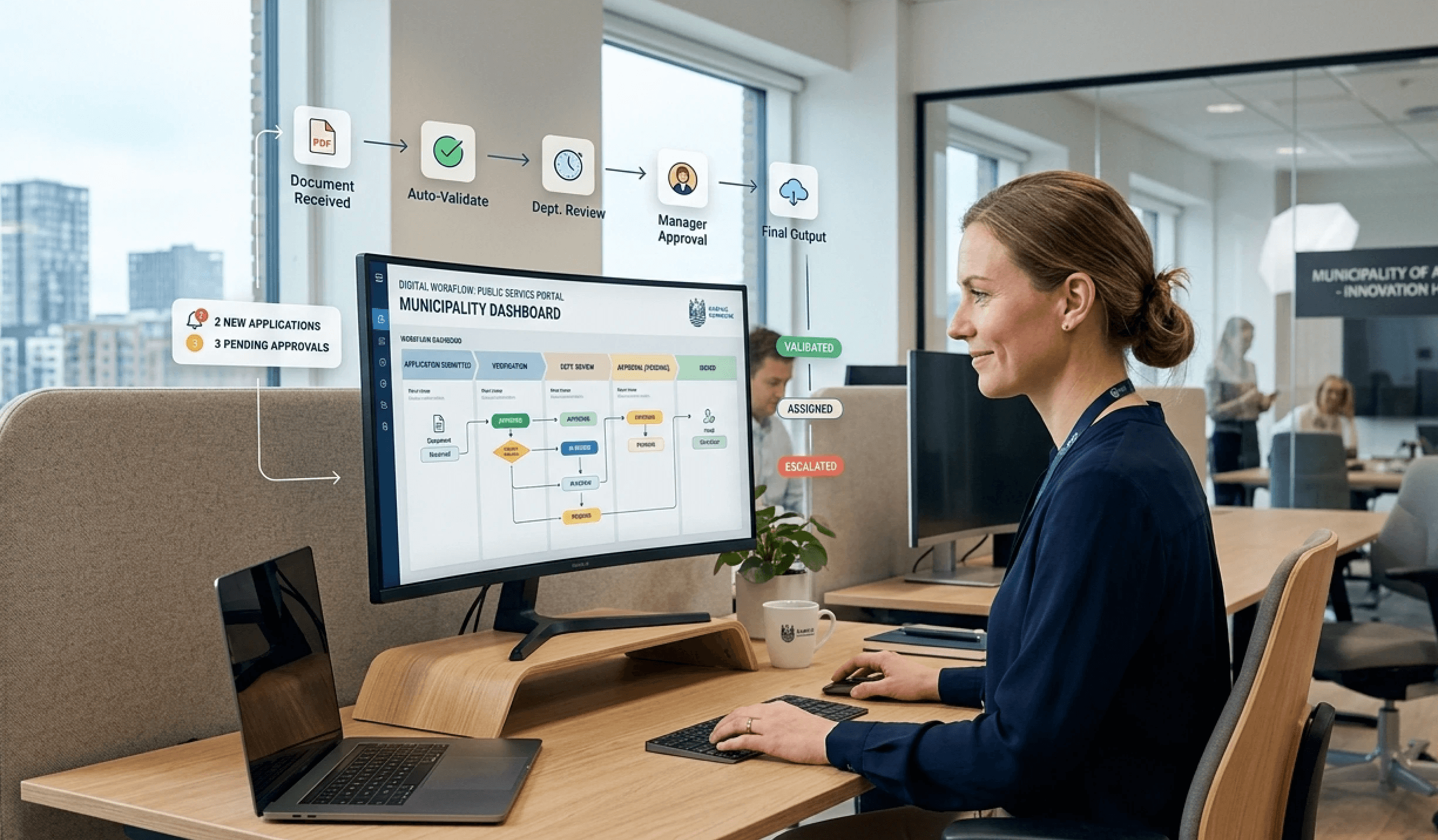
A municipality, a hospital, or a utility company rarely first discovers a compliance problem when the system fails. It typically happens when a manager needs to find a policy, an employee cannot document an approval, or a supervisory body asks who changed access rights and why it occurred without traceability. At that moment, compliance software stops being an IT project and becomes an operationally critical response to something very concrete: namely, whether the organisation can prove that it manages its processes properly.
In a Danish context, this question has become sharper, not softer. The GDPR era has made documentation, audit trails, and accountability a part of everyday life, and the financial consequences are clear at the EU level, where GDPR fines as of 1 March 2025 had reached approximately €5.65 billion according to Sprinto's compliance statistics. At the same time, compliance professionals spend an average of 9.5 hours a week on compliance tasks, up from 8.1 hours in 2023, and businesses estimate that automation can free up 3-5 hours a week. These are not minor adjustments; they are management signals that manual work no longer scales.
What is compliance software and why is it relevant in Denmark
A Danish manager should understand compliance software as more than just a place to store policies. It is a system that helps the organisation manage, document, and prove compliance with requirements, so it can be demonstrated to management, regulators, and other stakeholders that processes have actually been followed. When it functions correctly, the software does not replace judgment; it makes judgment traceable.
The scenario is recognisable. A municipality undergoes a regulatory inspection, and suddenly HR, IT, the DPO, and the relevant department must find versions of policies, access logic, and decisions made months earlier. If the material is buried in email threads, spreadsheets, and local drives, the organisation ends up with a treasure hunt, not an answer.
What compliance software is
Compliance software is a platform to gather audit trails, policies, approvals, follow-ups, and documentation into a single manageable structure. The central point is not that everything can be registered, but that changes can be tracked and responsibility can be assigned. For Danish public and regulated organisations, this is crucial because documentation without traceability quickly becomes worthless in practice.
Practical rule of thumb: If an auditor or regulator cannot see who did what, when, and on what basis, then the process is not documented well enough.
What compliance software is not
It is not a substitute for governance, and it is not just another task management tool. A checklist in itself does not solve the problem if the organisation lacks shared procedures, clear ownership, and continuous updates. Compliance software is therefore best understood as the digital framework that makes governance manageable.
This is also where many organisations make a mistake. They buy a feature but lack an operating model. The result is a system that looks good on paper but does not help employees in their daily work.
Why it is extra relevant in Denmark
Danish municipalities, regions, hospitals, and critical infrastructure rarely work with just one type of regulation. GDPR, archiving requirements, security standards, and vendor management overlap, making manual handling cumbersome. Therefore, compliance software in Denmark is not a luxury; it is a management layer that must be able to hold multiple requirements together without losing the overview.
Core features that make compliance software a real management tool
The most significant mistake in the market is treating compliance software as a feature list. The right question to ask is whether the solution can withstand an audit, a regulatory inspection, and an internal review without employees having to reconstruct history afterwards. This requires features that exist not for decoration, but for proof.
Immutable audit trails and timestamps
An audit trail is only useful if it cannot be rewritten without a trace. This is why immutable audit trails and timestamped entries are minimum requirements in Danish public and regulated environments, as also highlighted in the requirements for software compliance documentation at DataParc. Without this structure, it becomes difficult to document version history, responsibility, and the sequence of decisions.
Here, organisations must ask a simple question that cuts through the sales pitch: Can the solution reconstruct the sequence of events, or can it only show the latest status? If the answer is the latter, it is not strong enough for high-compliance environments.
Role-based access and policy management
Role-based access control is not just about security, but about reducing operational errors. The right person must have access to the right policy, the right workflow, and the right report, and no one else. When access is managed at the role level, it also becomes easier to document why an employee was able to view or change something.
Policy management and version control are equally important. A policy without version history is just a document. A policy with approvals, deadlines, and a change log is a management tool.
An organisation must be able to answer three questions without digging through folders, emails, and local drives: who approved it, what changed, and when did it happen.
Automated reporting and audit trails
Automated reporting is not a nice-to-have when management wants to see the status of compliance. It is the part that turns compliance into an ongoing management task instead of an annual clean-up. In practice, this means the organisation can extract overviews of tasks, deficiencies, and approvals without gathering data manually.
If a choice must be made between a pretty dashboard and real traceability, traceability must win. A dashboard without reliable sources only creates an illusion of control.
For organisations wishing to structure documents and processes in a more unified way, this review of document management is relevant as a closely related perspective. It points to the same basic principle, namely that documents and decisions must be searchable, understandable, and reusable.
From spreadsheets to platform: the historical development of compliance
Before GDPR, many organisations worked with compliance as a series of local solutions. Spreadsheets, paper files, and ad hoc approvals were common because the task was less visible and less central to management. This worked until the requirements grew, and the documentation burden followed suit.
GDPR changed the rules of the game. Instead of compliance being an internal routine, it became an area with direct financial consequences, and this is a major reason why compliance software emerged as a category. On the market side, estimates show that compliance software in 2025 is valued at USD 35.82 billion and is expected to reach USD 78.85 billion by 2033, with an annual growth rate of 10.5% from 2026 to 2033, according to Grand View Research.
Why growth says something about the operating model
The figures do not just tell the story of a market; they tell of a shift in working methods. Compliance has moved from reactive control to being an operationally critical platform for management and documentation. This is also why automation plays a larger role, as manual processes can no longer keep pace with volume or complexity.
Another analysis of the same market places the market at USD 28.74 billion in 2023 and USD 56.92 billion in 2030, with a CAGR of 10.25%, supporting the same picture of an established infrastructure category.
What it means for Danish organisations
For Danish decision-makers, this development means that compliance can no longer be treated as a side project in legal or IT. It has become a field of work that requires systemisation, traceability, and cross-cutting access to documentation. As organisational requirements grow, the solution must be able to support audits, operations, and everyday work.
The historical shift is therefore simple to state: Paper and spreadsheets were enough when compliance was narrow. They are not enough when compliance is a continuous management discipline.
Data sovereignty, hosting, and AI as Danish requirements for compliance
In Denmark, the question is not just whether a solution can register control points. The crucial factor is also where the data is stored, who can access it, and whether the platform can be operated under a model suitable for public and critical organisations. This is where data sovereignty becomes a primary requirement, not an appendix.
The EU's AI Act has sharpened expectations for governance around AI systems, and the Danish Data Ethics Council's 2025 report points out that trust, transparency, and control over data use are central barriers to responsible AI application. In practice, this means that compliance software in Denmark is also evaluated on whether data can be hosted in the EU or on-premise, and whether the organisation can manage its own use of AI functions.
Hosting is a management choice, not just a technical choice
Danish municipalities, hospitals, and utilities should be skeptical of solutions where data residency is unclear. Colibo's data protection framework is an example of how hosting, operations, and security can be integrated within an EU-based model, but the point is broader than a single product. When data is processed close to the organisation's own governance, it becomes easier to keep track of responsibilities, supplier relationships, and audit requirements.
The same applies to integration architecture. A solution should be able to communicate with existing environments via APIs, so the organisation is not locked into a single platform. This reduces dependency and makes it easier to change, expand, or reconfigure without heavy migration costs.
AI requires clear boundaries
AI in a compliance context is useful, but only if the organisation can explain what the model uses and what it does not. If an internal assistant works on the organisation's own data, the governance must be just as clear as the functionality. Otherwise, you are merely shifting the risk from document management to data processing.
Clear recommendation: Select only platforms where the hosting model, access control, and AI usage can be explained to management, legal experts, and auditors without technical translation.
For public and high-security environments, secure operation is not an extra feature. It is the very prerequisite for compliance to be deemed compliant.
Three scenarios from the daily life of Danish sectors
The same compliance platform looks different depending on the sector. Municipalities often struggle with cross-cutting processes and many units, hospitals with large volumes of staff and sensitive data, and utility companies with stricter security and supplier management requirements. It is therefore a mistake to choose a solution based on a generic features list.
The municipality with changing staff and scattered documentation
A municipality typically has many departments, multiple management levels, and employees who do not all sit at the same desk. Here, compliance becomes a question of whether policies, procedures, and approvals are actually accessible in daily operations. A platform with centralised knowledge sharing and clear roles makes it easier to maintain consistent practices across departments.
In this situation, an intranet platform like Colibo can function as part of the setup because it gathers communication, documents, and workspaces in one place. It is not a replacement for compliance software, but it is a layer that can make internal procedures visible so employees do not have to guess.
The hospital with access control and rapid shifts
A hospital works with many users, multiple access levels, and high consequences for errors. Here, role-based access, traceability, and rapid access to current instructions are crucial because staff often need to act quickly. If the correct document cannot be found immediately, the procedure becomes weak in practice.
Hospitals should therefore prioritse solutions where compliance, communication, and search are connected. It is better to reduce the number of places employees have to search than to add another system that no one uses.
The utility company with secure operations and supplier requirements
In utility companies and other critical infrastructure, stability and supplier control are not theoretical topics. Here, compliance must support security, business continuity, and documentation without the organisation becoming dependent on too many external systems. Therefore, the hosting model, access control, and integration options are central from the very first meeting with the supplier.
In all three scenarios, the pattern is the same. Compliance becomes stronger when documentation, internal communication, and access to updated procedures function within the same everyday environment.
Implementation in practice: from mapping to go-live
The best implementation does not start with software configuration. It starts with mapping which requirements the organisation actually operates under, and who owns them. If this step is skipped, the team just builds attractive screens on top of an unclear regulatory foundation.
First the framework, then the structure
Map the relevant requirements first, for example GDPR, ISO 27001, NIS2, and sector-specific requirements. After that, the hosting model must be chosen to fit data requirements and risk profiles. Only when this is established does it make sense to configure roles, workflows, and access.
Integration and migration must be tightly planned
Organisations should decide early on whether the solution needs to interact with Microsoft 365, Google Workspace, or both. This is not just a technical matter, but about avoiding duplicate work and preserving work routines that employees already know. The migration plan must also account for which policies and procedures are moved first, and which can follow later.
Change management is the part that often fails
Many projects stall because training and ownership do not receive enough attention. IT can set up the platform, but line management must help bring it to life. If employees do not understand why the system changes their daily routine, go-live becomes just a technical milestone on a plan.
Quick check before launch: Are the rules mapped, are accesses tested, and do employees know where to find the updated version of what they need?
For organisations that want to keep costs and operations more predictable, a fixed implementation price and a monthly license model are often easier to plan than custom consultancy work. This does not automatically make the process simple, but it makes it more manageable.
The overlooked challenge: compliance adoption over control
Many organisations believe that more control logging automatically yields better compliance. It does not. If employees cannot find the current procedure, or if policies are hidden in systems they rarely use, more logging does not help much. The issue is often adoption, not control.
Why internal communication is a compliance factor
In municipalities, regions, and critical infrastructure, compliance is as much a knowledge-sharing problem as a documentation problem. Frontline staff, rotating temporary workers, and multiple locations mean that information must be easy to find, otherwise rules are not followed in practice. This is why internal communication and compliance must be thought of together.
An intranet platform with centralised search, mobile access, and a clear structure can be the piece that connects the system with behaviour. It is not enough for a policy to exist. It must be findable quickly by the right employee at the right time.
Usability beats complexity
When a platform is difficult to use, it creates extra support needs. When it is easy to understand, it fits naturally into everyday life. This is a major reason why solutions with low training barriers and clear information interfaces deliver more value than systems requiring specialist knowledge for every action.
Here is a simple way to prioritize:
Make access easy: Employees must be able to find current procedures without knowing the system's structure.
Gather multiple sources in one place: Policies, guidelines, and follow-ups should be close enough together that the user does not give up.
Support mobile use: Frontline staff do not always work at a PC, so access on the go is necessary.
Build in feedback: If people cannot report ambiguities quickly, errors will keep returning.
The creation of management models for change becomes relevant precisely here, because adoption does not happen by itself. It must be managed, measured, and repeated; otherwise, the system ends up as a quiet archive.
Checklist and recommendation for Danish organisations
The correct evaluation of compliance software begins with a simple checklist. Not because compliance is simple, but because organisations can easily get caught up in features that look impressive but do not solve the most important requirements. This decision framework should lie with management, not just with IT.
Checklist when choosing compliance software in Denmark
Criterion | What you should investigate | Why it is crucial in DK |
|---|---|---|
Regulatory Mapping | Whether the solution can support the requirements the organisation actually operates under | Danish public and critical environments often work with multiple regulations simultaneously |
Audit trails | Whether changes, approvals, and actions are traceable and timestamped | Without traceability, documentation becomes weak during audits and regulatory inspections |
Access Control | Whether access can be managed by role and responsibility | Protects personal data, health data, and sensitive operational information |
Hosting and Data Sovereignty | Whether data can be hosted in the EU or on-premise | Important for public and security-critical organisations |
Integrations | Whether the solution works with Microsoft 365, Google Workspace, and other systems | Reduces friction and makes implementation realistic |
AI Governance | Whether AI features operate under clear data boundaries | Necessary when the organisation wants to use AI without losing control |
Adoption and Communication | Whether employees can quickly find procedures and updates | Compliance collapses if usability is low |
The brief recommendation
Compliance software should be chosen as part of an overall management model, not as an isolated tool. An intranet platform with a compliance foundation, such as Colibo, can be included as part of that model because it gathers internal communication, knowledge sharing, role-based access, Danish/EU hosting, ISO 27001, and ISAE 3000 auditing, alongside integrations with Microsoft 365 and Google Workspace. This does not make it a substitute for governance, but rather a practical framework for making governance work in daily life.
If a municipality, region, or utility company wants to reduce the risk of cluttered policies, unclear access, and weak traceability, the next step is to gather requirements and test the platform against them. Visit Colibo and evaluate whether an intranet platform with a compliance foundation can fit into your organisation's own model for documentation, communication, and data sovereignty.