

Danish hosting for intranets: What should organisations be aware of?

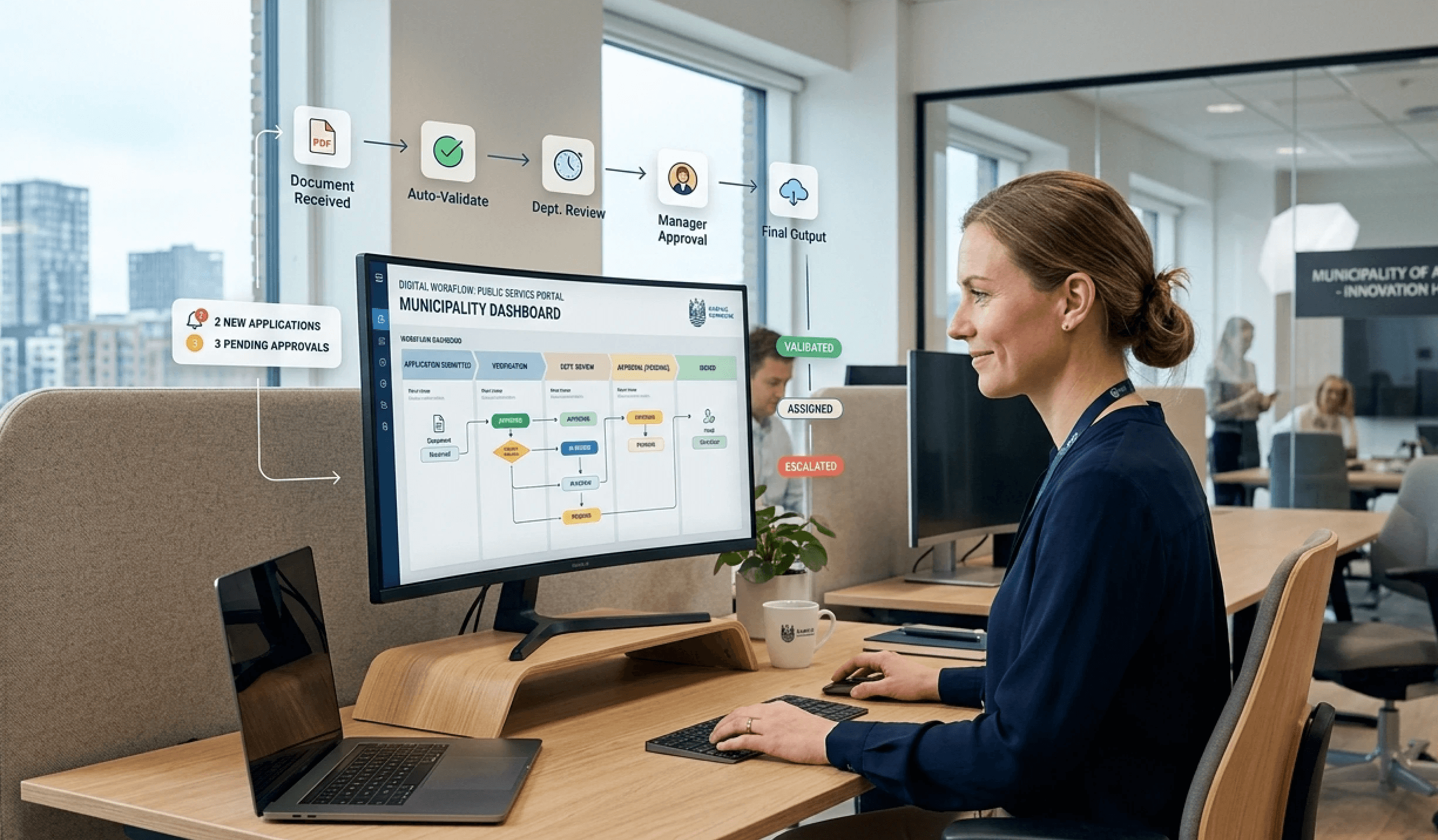
A municipal IT manager sits with three intranet vendors in front of them. All offer cloud. Several write Danish or European hosting. But where are the organisation's data actually located? Who has access to them? How is the platform restored after an incident – and what happens if the organisation later wants to switch vendors?
For municipalities, utilities, healthcare organisations and other organisations with high demands on operations and data security, hosting is therefore not just a technical choice. When the intranet gathers internal communication, procedures, documents and access to work tools, hosting becomes part of the organisation's governance, data sovereignty and contingency planning.
When the data centre moves home with you
An IT manager in a medium-sized municipality often gets the same question from both finance and management. Can the solution be placed in Denmark, and can it at the same time withstand a real operational crisis? It is a reasonable question, but it is also a question that reveals whether the organisation thinks in terms of location or in terms of contingency.
A Danish data centre is not automatically a secure data centre. If the vendor cannot show clear segmentation, documented backup and a plan for access after an incident, the local postcode is mostly a sales argument. Municipalities, regions and utilities cannot afford to buy an attractive location and a weak operational model.
Practical rule: Always ask who can still access the data if the vendor experiences an operational outage, a security incident or an audit requirement. If the answer is unclear, the solution is not ready for public sector operation.
This is also where many organisations confuse hosting in Denmark with secure hosting in Denmark. The first only says something about geography. The second must be able to document access control, recovery, audit trails and responsibility in practice.
For a municipality, it is about case handling, intranet, operational information and access to internal workflows. For a hospital, it is about reliable access to communication and exchange of information without unnecessary downtime. For a utility or other critical player, it is about ensuring that data and operations do not become dependent on a single vendor's good will.
What cloud hosting actually means
Cloud hosting is often confused with standard hosting, but they are not the same. Classic hosting is like an apartment, where you live in a fixed framework and move around with limited options. Managed cloud is more like a rented office, where operations are shared but the setup is more flexible. Private cloud is like an entire office building, which you design and manage yourself.
Three terms that decision-makers should know
Cloud hosting means in practice access to IT resources over a network, where capacity can be scaled as needed, and where the user themselves or via a vendor can modify resources without starting over. It is a different logic than an older web hotel, where there are often very rigid frameworks. Colocation is also not the same, because in colocation you typically own the hardware and simply place it with an operational partner.
In vendor materials, three models often appear:
Infrastructure as a Service, where the organisation gets servers, storage and network as a platform.
Platform as a Service, where the vendor also takes on more of the underlying platform operations.
Software as a Service, where the application itself is delivered as a service, and the customer primarily uses it.
The name is not what matters. What matters is who bears the operations, security, backup and recovery when something goes wrong.
What managed cloud adds in practice
Managed cloud provides the most value when the organisation does not have its own full operations team. Then the responsibility does not just shift to "the cloud", but to a vendor who must monitor operations, handle patching, take backups and provide support. This is particularly relevant for public and semi-public organisations where the IT department must deliver stability without being staffed like a large hosting company.
That is also why a quote list must be read with great skepticism. A product may well be technically "cloud", but still be so locked down that the organisation does not get the flexibility they think they are paying for. That type of mistake is often only spotted when an integration project, a search or a security check is initiated.
Why Denmark stands out as a cloud market
Denmark is not an immature market just discovering cloud. OECD and Eurostat show that 70% of Danish companies purchased at least one type of cloud computing service over the internet in 2023, while the EU average was 45%. The OECD also highlights a DCCA study showing 72% in 2024. This places Denmark significantly above the EU average and points to a mature market with high basic digital acceptance. The source material is the OECD and Eurostat document on cloud use in Denmark and EU20/en/pdf).
Maturity changes the requirements
When cloud is widespread, vendors cannot get away with just selling promises. They must be able to document operations, security and access models that hold up in practice. This applies particularly to municipalities, hospitals and utility companies, where continuity itself is purchased, not just compute capacity.
IBISWorld also describes that the Danish Data Processing & Hosting & Website Operating industry had a market size of €3.4 billion in 2026, with 1,067 companies, an annual revenue growth of 9.7% and a long-term company growth of 0.1% CAGR. This points to a consolidated sector where scale and operational experience matter more than being new and cheap. The same source also states a Danish cloud service market of USD 2.82 billion in 2024 and an expectation of USD 6.33 billion in 2032, corresponding to 12.25% CAGR. See IBISWorld's market description of Danish data processing and hosting.
When the market is so mature, the question is not whether cloud can be used. The question is what requirements must be built in from the start so that the solution can also pass an audit and survive an incident.
This is also why Danish providers typically offer clearly defined profiles with CPU, RAM and NVMe as sales parameters. It signals a market where capacity and operational design have been standardised, but also where the difference between standard web hosting and an actual cloud platform is clear. For buyers, this means that price is rarely the right first comparison factor.
Public, private and hybrid hosting in practice
The choice is rarely between "good" and "bad" hosting. It is between three operational profiles that solve different problems. For Danish organisations, it is important to distinguish sharply, as data sovereignty, operations and integrations often pull in different directions.
When public cloud is enough
Public cloud typically fits workloads with lower sensitivity and high standardisation. This can be standard intranet, file access or email, where scaling and rapid deployment carry weight. For organisations with many users and relatively uniform needs, it is an efficient model, as long as security and access restrictions are clearly set up.
When private cloud makes sense
Private cloud is relevant when data sovereignty, segmentation and control over operations are more important than rapid standardisation. This often applies to hospitals, municipalities and utilities, where there are requirements for predictable access, logging and clear division of responsibility. Here, a dedicated instance in Denmark or with a Danish provider is often more appropriate than a broad shared platform.
Hybrid as the practical middle ground
Hybrid managed cloud is the model many end up with because it allows sensitive data to be placed locally while letting less critical services run more scalably elsewhere. It is also the model that best suits organisations that do not want to choose between total centralisation and total freedom. Here, the architecture is about managing the boundaries, not about gathering everything in one place.
Comparison of hosting types for Danish organisations | |||
|---|---|---|---|
Profile | Typical use in DK | Data sovereignty | Operations owner |
Public | Standard intranet, files, mail | Limited to moderate, depends on setup | The vendor |
Private | Healthcare data, critical internal systems, sensitive workflows | High, if operations and location are controlled | The organisation or dedicated vendor |
Hybrid | Municipal platforms, utility solutions, mixed portfolios | Flexible, if boundaries are clear | Shared between the parties |
The technical profiles seen in Danish offers also show the leap between standard hosting and actual cloud. When working with VPS profiles, NVMe and multiple worker processes, it is a sign that the platform is built for more than just static web pages. This is important for platforms with search, feed updates and integrations to Microsoft 365 or Google Workspace.
GDPR, ISO 27001 and ISAE: what the difference actually is
Many vendors write "GDPR-compliant" in their material, but this is not a prize you can buy. GDPR is a legal requirement that obligates both data controllers and data processors. ISO 27001 and ISAE 3000, on the other hand, are documentation types that say something about how security and controls are managed and audited.
Three different disciplines
GDPR is about processing personal data and who bears the responsibility. A Danish organisation cannot outsource its responsibility and think that a hosting agreement solves everything. A proper data processing agreement is therefore not a formality, but a central part of governance.
ISO 27001 is an information security management system. The certification shows that the vendor works systematically with risks, controls and improvements. It is not a guarantee that nothing can go wrong, but it is a strong sign of operational maturity.
ISAE 3000 or ISAE 3402 is an independent audit report on controls. It is the type of documentation that helps a municipality, a hospital or a utility assess whether the vendor's claims also hold up in real operations. This is where you see what has been tested, over which period, and with what results.
Documents that should be on the table
Data Processing Agreement: It must describe the division of roles, sub-processors and security measures.
ISO 27001 certificate: It should show the issuing body and validity.
ISAE statement: It must show the coverage period and exactly which controls have been assessed.
Exit and deletion terms: The organisation must be able to retrieve data in a controlled manner.
If a vendor cannot present this without hesitation, the vendor is not ready for critical workflows. For a more detailed technical and organisational framework, this ISO certificate page at Colibo can be used as an example of how certification and documentation are typically presented in practice.
Latency, redundancy and SLA in Danish environments
Technical terms like latency and SLA are often used as decoration. That is a mistake. For Danish organisations, those words are decision criteria because they determine whether a platform is suitable for daily operations, or whether it just looks good on a slide deck.
What is felt by the users
When a solution has low network latency, search, content updates and login feel more stable for employees. DK Cloud Solutions indicates a low-latency network with under 2 ms to Copenhagen and under 5 ms to Nordic capitals, together with Tier III+ design, 99.982% availability, N+1 redundancy, dual-stack IPv6 and DDoS protection up to 10 Gbps. See their service page on operational and network design. For a public organisation, this is relevant because local data placement is not enough if the network is unstable or the architecture cannot tolerate failures.
Operational rule: SLA without redundancy is just text. If the architecture is not built to survive a node or zone failure, the uptime promise is not worth planning around.
Single-AZ and multi-AZ are not just technical words
In Danish environments, the difference between single-AZ and multi-AZ is crucial when a system is used for internal communication, operational information or critical work processes. Multi-zone design is more reliable because a single failure does not necessarily crash the entire solution. This is the right model when the organisation cannot accept prolonged downtime.
RPO and RTO must be thought in at the same time. If backups are only taken rarely, data loss will be greater. If failover is not tested, recovery will be slow. That is why contingency exercises must be just as concrete as an operational agreement.
For a practical framework on continuity and recovery, this Business Continuity page at Colibo can be used as an example of how organisations can think about operational reliability and recovery in context.
Migration and operational considerations before you switch
Most problems do not arise when the contract is signed. They arise when data needs to be moved, integrations need to work, and users expect everything to look like it did before. This is where many projects lose momentum because the migration plan is too optimistic.
The typical pitfalls
First comes the data export. Metadata, associations and history must come along, otherwise the organisation loses searchability and coherence. Then come the integrations, especially to environments like Microsoft 365 or Google Workspace, where access, calendar, notifications and user accounts must interact with the rest of the portfolio.
Then search, notifications and any AI features must be tested before go-live. If a platform cannot find the right content quickly, or if alerts drown in noise, users will become frustrated from day one. A rollback plan is therefore not an extra document, but part of the migration itself.
When the vendor is hit by an incident
The CloudNordic case showed how quickly backup, segmentation and access can become business-critical issues when a vendor is hit by ransomware. An organisation that has not built incident response and data availability in from the beginning stands weak when something goes wrong. The same applies to power outages or breaches of compliance.
If the solution's data access cannot be maintained during a crisis, the solution is not reliable enough for public or critical operations. That is why backup segmentation, recovery testing and a clear support path are necessary requirements, not bonuses.
For a broader organisational framework, this data protection page at Colibo can be used as a reference for how data management and access are thought into the solution.
Your checklist before choosing cloud hosting in Denmark
A vendor screening must be tough, not polite. If the organisation works with citizens, patients or critical operations, the questions must be precise from the very first meeting. Price alone does not determine the right choice.
Check these points before contracting
Data location: Are data stored in DK or the EU, and can this be documented?
Compliance: Is there a proper data processing agreement, and are the requirements tailored to your sector?
Certification and audit: Are ISO 27001 and a relevant ISAE statement current and comprehensive?
Uptime and recovery: What are the SLA, RPO and RTO levels, and have they been tested?
Operational reliability: Is there N+1, multi-AZ, DDoS protection and a clear exit plan?
Support: Is there Danish/English support, also when the incident hits outside normal working hours?
The critical question is simple. What happens on day 1 if the vendor experiences a serious incident, and who owns access to your data afterwards? If the answer requires long explanations, the vendor is not ready for your organisation.
Colibo delivers an intranet platform with Danish/EU hosting, integrated AI search and the option of running in both cloud and on-premise, so organisations can manage data access and internal communication without getting locked into one model. For municipalities, hospitals and critical infrastructure, it is relevant to see platforms like Colibo as part of the overall contingency and governance solution. Visit Colibo and assess whether your requirements for reliability, audit and data access have been thought in from the start.