

7 intranet features transport companies should prioritise

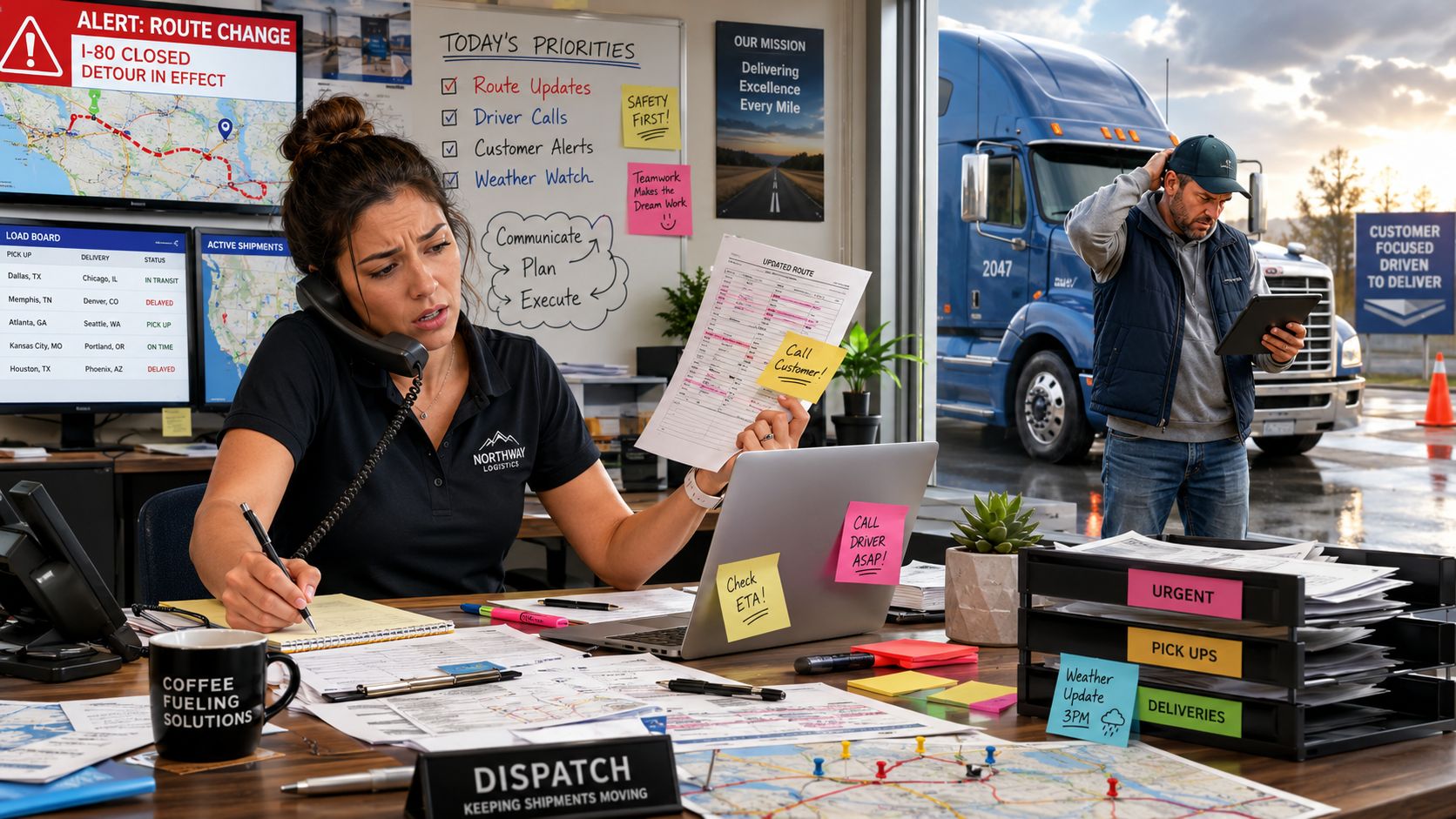
It is just after five. The dispatcher is informed of a route change, two drivers call in, a terminal manager is missing the latest instruction, and a warehouse team is still reading a message on a physical whiteboard that is already out of date. This is not a communication problem in a soft sense. It is an operational problem.
In transport, delays rarely occur only out on the road. They often start internally, when information is stuck in email threads, local folders, verbal handovers and individual phones. That is why it makes sense to look at 7 intranet features transport companies should prioritise as something more than internal communication. It is about connecting operations, safety and decisions across office, terminal, warehouse and employees on the move.
Why a modern intranet is business-critical in the transport industry
When operations depend on who happens to answer the phone
Many transport companies still run on a mix of email, telephone, paper, whiteboards and local drives. It works until something changes quickly. Then the quality of operations depends on whether the right person sees the right information in time.
This is precisely why a modern intranet should not be assessed as an HR project or an internal news channel. It must be assessed as an operational tool. Drivers must be able to find instructions from their mobile phones, planners must be able to send precise messages to the right groups, and managers must know where the current information is located.
According to DI Transport's analysis, in 2023 Danish transport companies and their employees contributed almost DKK 50 billion to society. When a sector has that weight, internal coordination is not administration. It is part of the critical operations of society.
An intranet only creates value in transport when it removes waiting times, doubt and local custom versions.
When internal communication becomes part of the delivery
The practical question is simple. Can the company send, find and update business-critical information without going through chains of phone calls?
For companies with workshop operations, equipment handling or special vehicles, the same applies. If a department, for example, works with containers or heavy equipment, technical service conditions can affect the day's plan. In that type of setup, it can be useful to have access to professional background knowledge such as få service med kroghejs (get hooklift service), because technical operations and communication flows often hang closely together in practice.
Three signs quickly show if the current solution is too weak:
Messages go through intermediaries because the frontline does not have direct access.
Documents are located in several places, so no one is completely sure of the current version.
Locations work differently because the same message is interpreted or received differently.
For a more practical review of the typical challenges, managers can also look at intern kommunikation i transport og logistik (internal communication in transport and logistics). The point is the same. When employees are scattered, information must be centralised.
The 3 most requested features right now
Mobile access first
The first feature is almost always mobile access. This is not due to fashion, but working conditions. Drivers, terminal employees, warehouse teams and operational staff are not tied to a PC. If the intranet is primarily built for the desk, the company loses touch with large parts of operations.
Mobile access solves three specific problems in particular:
Delayed information. Messages are no longer read only at shift changeover or on arrival at the office.
Dependence on local managers. Team leaders no longer have to be the sole channel.
Lack of self-service. Employees can look up procedures, contact paths and changes themselves.
According to ITD on growth and competitiveness, the Danish transport and logistics sector employs more than 40,000 people. This highlights the importance of choosing features that can scale communication and reduce coordination costs across drivers, freight forwarders and administration.
Targeted messages cut away noise
The next feature is targeted communication by role, location or team. Many intranets fail here. They send everything to everyone and call it transparency. In practice, it just creates noise.
A driver does not need the same message as the finance department. A depot at one end of the country should not be disturbed by local issues in another. When messages can be targeted, the intranet becomes useful in everyday life.
Practical rule: If a message requires action, the recipient group must be narrow and clear. Broad news can be shared. Operations must not be.
This also makes management communication sharper. Management can be more certain that important information actually reaches the relevant employees, instead of drowning in general posts.
Documents must be found quickly and be the right ones
The third feature is central document access. It is a classic, but it is still underestimated. In transport, the consequence of incorrect documents is not just irritation. It can lead to errors in workflows, uncertainty about safety rules and unneeded clarifications.
Here, it is crucial that document management is not just a file archive. It must work operationally:
Need in operations | What the intranet must be able to do |
|---|---|
Current instructions | Show one current version |
Local variations | Control access by location or team |
Quick action | Make documents searchable from mobile |
Safety and compliance | Gather procedures, emergency plans and guidelines in one place |
When companies gather safety instructions, operating procedures, onboarding material and HR information in one common point of reference, the need for local copies falls. This also makes it easier to maintain quality.
A good yardstick is whether the frontline can resolve the most common questions without calling the dispatcher, team leader or HR. If the answer is no, the document access is not good enough.
For managers evaluating platforms, it is worth looking at specific funktioner i et moderne intranet (features of a modern intranet) and comparing them against everyday operations, not against a generic wish list. This is where the first three priorities usually become clear.
4 other essential features for effective operations
Real-time notifications when minutes matter
The fourth feature is real-time notifications. This is not the same as regular news. News can be read later. Real-time notifications should be used when information changes behaviour here and now.
A typical example is a route change early in the morning. A planner sends a targeted notification to the drivers affected. The message links directly to the updated route information, so the driver can change course before the vehicle reaches the original terminal. The benefit is not "engagement". The benefit is that the planner does not have to call around, and everyone gets the same message at the exact same time.
In its recommendations on public transport, Dansk Industri (the Confederation of Danish Industry) points out that quality depends, among other things, on "ease and transparency", "speed" as well as "safety and reliability". This captures precisely why targeted notifications and fast access to information matter in operations.
Social feed and professional communities
The fifth feature is a social news feed with groups or professional communities. This sounds softer than the other features, but it is often where knowledge travels fastest between locations.
It works when the purpose is concrete. A warehouse team can share a practical solution on goods reception. A terminal can warn about a recurring problem. New managers can follow what is actually taking up space in operations. It does not work if the feed is filled with general campaigns and content with no relevance to the working day.
The best social intranets in transport do not look like an internal Facebook. They look like a place where employees more quickly find colleagues' solutions.
Digital onboarding that works without a desk
The sixth feature is digital onboarding. Many transport companies find it difficult to create a uniform start for new employees because the introduction takes place locally and verbally. The result is uneven.
A digital onboarding does not have to be long and pretty. It has to be useful. New drivers and terminal employees must be able to quickly find safety instructions, contact paths, local procedures and the most important operational rules. If the intranet can deliver this in a simple, mobile-friendly form, the start-up becomes less vulnerable to busyness and dependence on individuals.
Tasks and workflows without paper and detours
The seventh feature is task management and simple workflows. Hidden friction often lies here. Many companies still handle holiday requests, equipment orders, reports and local approvals via email, paper or messages back and forth.
An intranet does not need to replace all professional systems to make a difference. But it should be able to digitise the small, recurring processes that otherwise steal time.
Four typical areas are worth starting with:
Absence and requests. Simple flows replace confusing email threads.
Equipment and error reports. Employees know where to register needs or problems.
Local approvals. Responsibility and next steps become visible.
Standard tasks. Repetitive routines become uniform across locations.
From features to solution with AI and integrations
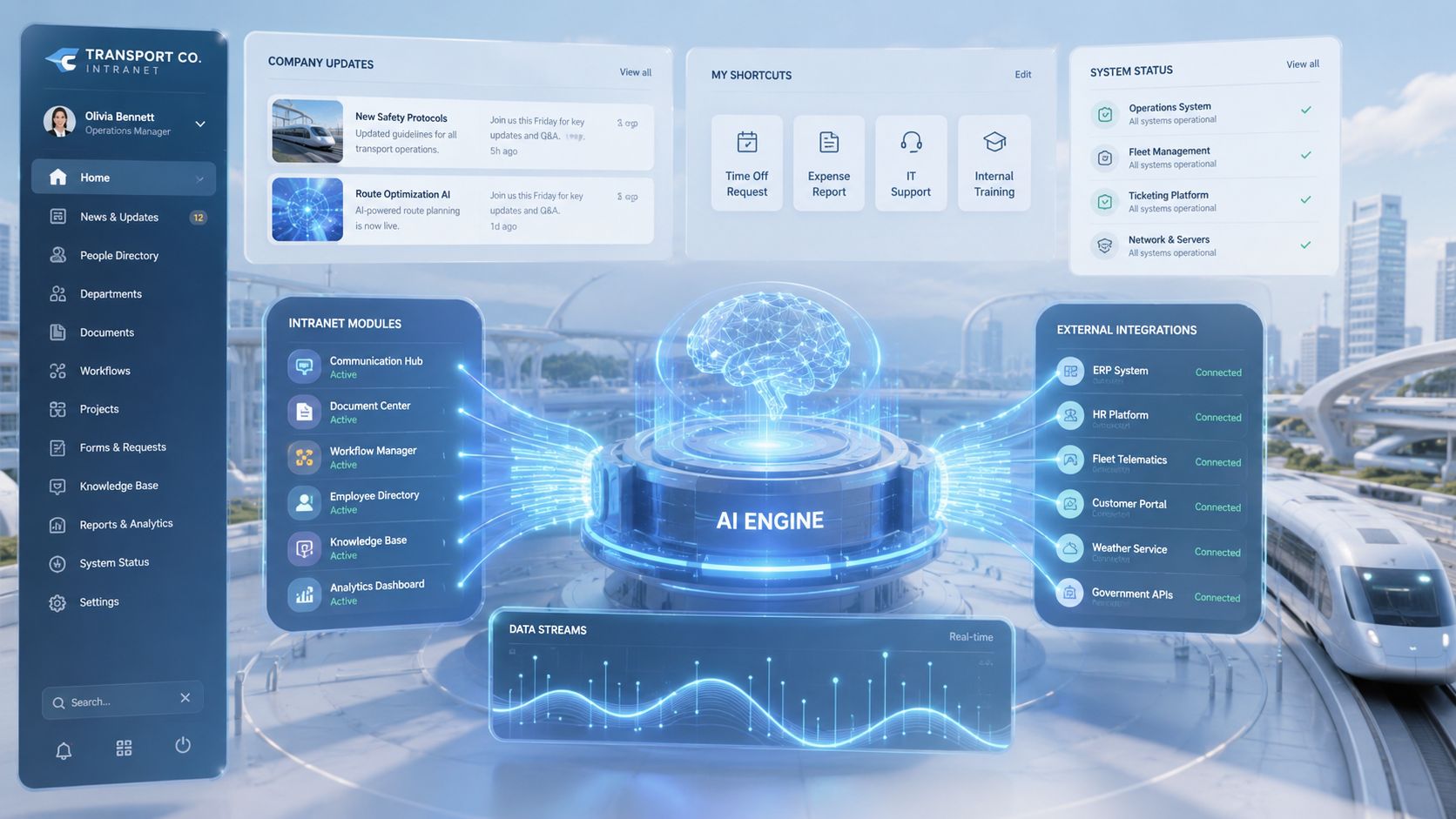
AI provides quicker answers to concrete operational questions
Many companies make the same mistake when choosing an intranet. They buy features individually and hope that the value arises by itself. It rarely does. It arises when search, documents, news, notifications and workflows work together.
This is where the AI assistant becomes interesting. Not as a gimmick, but as a shortcut to the company's own data. A driver or terminal employee should be able to ask a question in plain language and get answers based on current instructions, documents and content on the intranet. This is far more useful than flipping through folders or calling around for help.
According to Altinget's article on ITD's priorities, in an industry pressured by driver shortages and efficiency demands, the value of an intranet lies not only in engagement, but in measurable impact on operations. The most valuable features are those that link communication and knowledge directly to daily logistics management, and reduce wasted time for mobile employees.
This is also why companies should look at AI in relation to concrete questions like these:
Can employees get answers based on their own intranet data, not open web content?
Can AI point further to the right document or the right procedure?
Can the solution be used from mobile without extra complexity?
Integrations determine whether the intranet helps or disrupts
Integrations are the other half of the value. If the intranet lives its own life alongside shift planning, HR data and other daily tools, it quickly becomes yet another system that employees must remember to visit.
A better solution is a digital workspace where relevant data meets. Here, for example, an AI feature like AI-chatbot til intranet og videnssøgning (AI chatbot for intranet and knowledge search) can be used as a layer on top of the information the organisation has already gathered. It does not make search magical. But it makes it more direct and less dependent on the employee knowing the right folder or the right file name.
Colibo is one example of a platform that combines the intranet, mobile access, AI assistant and integrations in the same environment. This is relevant in transport if the goal is to gather communication, documents and operational information instead of scattering them over several solutions.
The intranet as a contingency tool in times of crisis
Contingency planning requires more than a contact list
Many managers first think of the intranet as a tool for everyday use. That is a mistake. In transport, the real value often becomes clearest when normal operations break down.
Industry sources like Danske Speditører (Danish Freight Forwarders) call in Altinget's coverage of total contingency in the transport sector for the transport sector to become a closer part of total contingency. This highlights the need for intranet features that can handle business-critical messages, escalation and role-based information when normal workflows break down.
This changes the requirements for the platform. A contact list and a document archive are not enough. Emergency preparedness requires that specific groups of employees can be reached quickly, that updated plans are easy to find, and that access can be controlled by role and situation.
The right setup during disrupted normal operations
An intranet that is to function in times of crisis should, as a minimum, be able to do this:
Send targeted emergency messages to specific locations, teams or driver groups.
Gather emergency plans centrally so no one works according to old versions.
Support escalation so managers and key personnel know who is acting on what.
Function on mobile because many critical employees do not sit at a desk.
Good contingency planning is also built on access to external practical resources when incidents affect vehicles directly. If a company wants to gather knowledge on handling breakdowns and roadside assistance, a professional reference like regler og priser for bugsering (rules and prices for towing) can be useful as a supplement to its own procedures.
When supply, traffic or deliveries are disrupted, the intranet is not an information channel. It is part of the chain of command.
Conclusion: How to choose right
A good intranet for transport does not look like a social media platform with some extra document sharing. It looks like an operational tool. Therefore, the choice should not start with design, likes or general feature lists. It should start with the errors, delays and dependencies the company wants to eliminate.
In practice, the 7 intranet features transport companies should prioritise are these: mobile access, targeted messages, central document access, real-time notifications, social professional communities, digital onboarding as well as task management and simple workflows. When they work together, the company gets a faster flow of information, less local custom practice and better support for employees on the move.
Use this short checklist when evaluating solutions:
Does it solve a concrete operational problem, or does it just look good in a demo?
Can the frontline use it from mobile, without extra detours?
Can information be targeted precisely, so employees do not drown in noise?
Are documents, search and workflows connected, so work actually becomes easier?
Is the platform resilient enough for emergency preparedness, not just for everyday life?
Do architecture and hosting requirements match the company's need for data sovereignty and operations?
The most sustainable choices are typically platforms with a mobile-first approach, the option of Danish or EU hosting and an architecture that can stand on its own feet while integrating with existing systems. This is how the intranet goes from being internal communication to becoming a real part of the transport company's competitiveness.
If the goal is to gather communication, documents, mobile access and AI-based knowledge search in one solution, Colibo is a relevant platform to evaluate. The most important thing is not the name of the system, but whether it can support your daily operations, your contingency planning and your employees on the move.