

Intranet in 2026: 14 ways a modern intranet strengthens internal communication and digital transformation

The intranet has long since become much more than a place for document management. In an era where AI, hybrid working and digital transformation are changing day-to-day life in most organisations, the intranet has moved from "boring document portal" to a strategic partner that connects people, knowledge and culture.
The need is real. Gallup's State of the Global Workplace 2026 shows that only 20 % of employees globally are engaged in their work, and that low engagement costs the global economy an estimated 10 trillion dollars a year in lost productivity. At the same time, McKinsey Global Institute points out that knowledge workers spend up to 20 % of their working week looking for internal information – time that often disappears between emails, folders and colleagues who can't be found.
This is exactly where a modern intranet makes a difference. When used correctly, it becomes the foundation for internal communication, the digital workspace and change management. Below you will find 14 perspectives on how a modern intranet can support the organisation right now – with concrete points and sources you can take further.
1. The intranet as a driver of digital transformation

Digital transformation is rarely about the technology itself – but about getting people, processes and data to work together in new ways. A modern intranet keeps the organisation on the right course, even in uncertain times, because it brings strategy, communication and everyday tools together in one place.
Forrester and other analysts describe the intranet as the new digital employee experience platform (DEX) – the core of how employees experience change. When leadership messages, KPIs, project updates and discussion threads live side by side, change becomes less abstract and more tangible.
2. The intranet as a space for digital ethics

ESG, AI governance and responsible data use are no longer "nice to have". They are core topics in modern leadership. An intranet can be the place where the organisation openly discusses sustainability, AI guidelines and ethical dilemmas – and where policies are not just found, but also understood.
When employees can ask questions, comment on guidelines and see how leadership approaches ethical issues, a culture of openness is built that makes it easier to make conscious decisions in everyday life.
3. The intranet as an onboarding mentor

The first 100 days are crucial. Structured digital onboarding through the intranet helps new employees find their footing – whether they are newly qualified Gen Zers or experienced specialists starting in a complex organisation.
Research from the knowledge-management field suggests that companies with centralised onboarding documentation can significantly reduce onboarding time, because new employees get access to processes, FAQs and videos from day one. At the same time, their profile and skills become visible to the rest of the organisation, so they more quickly become part of the community.
4. The intranet as a link between human knowledge and AI
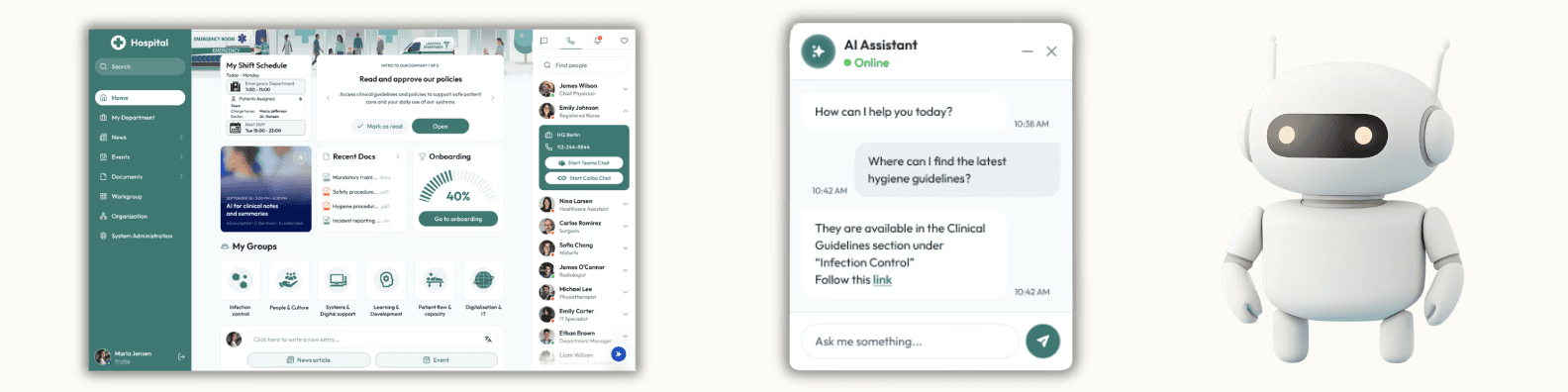
AI is the most talked-about intranet trend in 2026. LumApps, ThoughtFarmer, Sociabble and other analysts all highlight that AI-driven search, contextual recommendations and generative agents are redefining what an intranet can be. In 2026, employees expect to be able to ask a question in natural language and get a clear answer – not a list of link results.
But AI is only as good as the knowledge it is fed. The intranet therefore becomes the place where human knowledge is collected, structured and quality-assured – so AI can deliver it to the right people at the right time.
5. The intranet as a way to put customer needs at the centre

When sales, marketing, support and product development share customer insights in the same space, the customer's voice becomes part of everyday life – not just an item on a quarterly meeting agenda. An intranet can house case studies, customer feedback, "lessons learned" and joint campaigns.
McKinsey has shown that organisations where employees are connected across functions can increase productivity by 20-25 %. The same effect is seen in customer satisfaction when information no longer gets stuck in silos.
6. The intranet as a tool to strengthen employees' voice

One of the biggest changes in modern internal communication is the shift from one-way communication to dialogue. A modern intranet gives everyone in the organisation – including frontline employees who do not sit at a desk computer – the chance to comment, share, like and contribute.
This is more important than ever. Gallup reports that 20 % of employees experience loneliness on a typical working day, and among remote employees the figure is even higher. When employees are heard and taken seriously, the sense of disconnection falls – and engagement rises.
7. The intranet as a digital workspace

For hybrid and distributed teams, the intranet is where the organisation "comes together" – wherever employees are physically located. A unified digital workspace reduces what analysts call "tool sprawl": the growing number of apps and platforms that pull employees' attention in every direction.
Harvard Business Review has highlighted that employees who feel part of a community are up to 3.5 times more likely to contribute their full potential. It is an investment in both culture and the bottom line.
8. The intranet as the organisation's digital twin

For younger generations, the digital is not an "extra layer" – it is everyday life. When an intranet reflects the living organisation – with faces, projects, events and culture – it becomes the organisation's digital twin. This is where you "meet" your colleagues, see who is doing what, and understand where you fit in yourself.
This is especially important in organisations with multiple locations, hybrid working or frequent change, where the physical meeting place is no longer the primary point of gathering.
9. The intranet as a space for resonance

Resonance is about capturing moods, trends and shared energy in the organisation. A modern intranet with analytics and engagement data can show which topics are capturing employees' attention, where information is missing and where energy is highest.
New analyses for 2026 suggest that predictive analytics and sentiment data will become one of the biggest intranet areas in the future. This moves the intranet from a static information hub to an active organisational feedback loop.
10. The intranet as the company's internal YouTube

Video has become a dominant format in internal communication – and for good reason. Short walkthroughs, leadership videos, project updates and employee stories convey more in 90 seconds than many long texts.
A modern intranet functions as the company's internal streaming universe: a place where employees create and share content themselves. It democratises communication and makes knowledge more accessible across generations and roles.
11. The intranet as a thinking box

Innovation rarely comes from a single department – it arises at the intersection of perspectives. An intranet can house idea platforms, innovation channels or "thinkbox" groups, where employees contribute input that leads to real initiatives.
Studies of strategic internal communication show that organisations that actively invite employee input into development processes experience higher engagement and faster readiness for change.
12. The intranet as a virtual coffee corner

Informality is not wasted time – it is the glue of culture. Spontaneous conversations, brief chats and shared rituals create trust and community. In a hybrid working day, many of the informal moments disappear if we do not actively create spaces for them online.
Research from workplace researchers (including Josefsson, 2021) suggests that structured "virtual coffee breaks", social channels and non-work-related groups strengthen social contact between colleagues – and thereby both wellbeing and collaboration.
13. The intranet as leadership's common room

Visible leadership is no longer optional. Gallup data shows that leadership engagement fell to 22 % globally in 2025 – and that a leader's engagement is the single factor that has the greatest impact on the team's engagement. An intranet where leaders write, share reflections, show their faces and are accessible makes leadership more human and transparent.
It is not just about CEO blogs. It is about the entire leadership layer – from team leader to senior management – using the intranet to show direction, listen and be present.
14. The intranet as a growth partner

Finally, a modern intranet can support both individual and organisational development. Learning programmes, skills profiles, mentoring programmes and course libraries are brought together in one place and become part of everyday life rather than a rare event.
When employees can see their own progression, find new opportunities internally and share learning with others, their sense of agency and independence is strengthened – key factors in modern employee experience research.
From document portal to strategic partner
The 14 perspectives above have one thing in common: They all point to the fact that the intranet has moved from being background infrastructure to being a strategic tool for leadership, culture and change.
For organisations in the midst of digital transformation, the most important question is therefore no longer "Should we have an intranet?" – but "How do we make our intranet support the organisation we want to be?"
A good starting point is to:
start with a clear strategic purpose, not a feature list,
involve employees early in the design,
prioritise mobile and frontline access from day one,
build governance and content ownership in from the start,
and measure adoption and engagement – not just logins.
When that succeeds, the intranet does not become "just another system". It becomes the place where the organisation meets, learns and creates change together.
Frequently asked questions about modern intranets
What is a modern intranet?
A modern intranet is a digital platform that brings internal communication, knowledge sharing, collaboration and employee tools together in one place. Where the classic intranet was primarily a one-way news channel, the modern intranet functions as an active digital workplace that supports dialogue, culture and day-to-day work processes – across departments, locations and units.
What is the difference between an intranet and a digital workplace?
An intranet is the foundation of the digital workplace, while the digital workplace is the overall ecosystem of tools employees use in everyday life. The intranet is typically the entry point and meeting place – the place where news, documents, profiles and specialist systems come together – while the digital workplace encompasses everything from Microsoft 365 or Google Workspace to CRM, HR systems and collaboration tools.
How does an intranet strengthen internal communication?
An intranet strengthens internal communication by bringing all messages together in one place, making room for two-way dialogue and ensuring that information reaches everyone – including frontline employees without a fixed desk. It replaces scattered emails, notice boards and chat groups with a targeted, searchable and measurable communication channel where leadership and employees can meet on equal footing.
What role does AI play in a modern intranet in 2026?
AI is one of the biggest drivers behind the development of the intranet in 2026. In practice, AI is used for intelligent natural-language search, personalised content, automatic tagging, summarising long documents and contextual recommendations. According to analyses from among others LumApps and ThoughtFarmer, the intranet is moving from being a static information portal to a conversational, context-aware employee assistant.
What functions should a modern intranet have in 2026?
The most important features of a modern intranet are mobile access, intelligent search, personalised content, integration with existing systems (e.g. Microsoft 365 or Google Workspace), social features, analytics and strong content governance. In addition, AI functions, frontline support and built-in security are becoming crucial in 2026 – especially for organisations with hybrid teams or many locations.
How do you get employees to use the intranet?
Adoption is created through relevance, usability and involvement – not through coercion or directives. The organisations that succeed best start with clear use cases, involve employees early in the design, prioritise mobile and frontline access, and use analytics to continuously adjust content and structure. Leadership's active presence on the platform is often the single most important factor.
How do you measure whether the intranet creates value?
The value of an intranet is measured by a combination of adoption (active users, participation), engagement (comments, reactions, shares), productivity (time saved searching for information) and cultural indicators such as employee engagement and belonging. Modern intranet platforms offer built-in dashboards that make it possible to track these parameters continuously and link them to the organisation's strategic goals.
Sources and further reading
Gallup (2026): State of the Global Workplace 2026 Report – global figures for employee engagement, leadership engagement and wellbeing.
Gallup (2025): State of the Global Workplace 2025 – data on loneliness in the workplace and the global productivity loss.
McKinsey Global Institute: The Social Economy: Unlocking Value and Productivity Through Social Technologies – on the 20-25 % productivity potential from connected employees and time spent searching for information.
Harvard Business Review: Research on belonging and employee contribution.
LumApps (2026): Top 7 Intranet Trends for 2026 / Top 8 Digital Workplace Trends for 2026.
ThoughtFarmer (2026): Top intranet trends for 2026.
Involv (2026): Your intranet in 2026: 7 trends you can't miss.
Sociabble (2026): Top 12 Intranet Trends to Watch in 2026.
Josefsson (2021): Research into virtual social rituals in the workplace.
Would you like to see how a modern intranet can support your digital transformation? Contact us and book a no-obligation demo.