


Internal communication in companies

7 tips to Spice Up the Internal Communication in Your Company
Is the internal communication in your company always in top gear?
Admit it; even though the communication is good, it could probably be optimised in several places, right? Especially the communication that is sent around between you. Do you experience, for example:
One-way communication: Information trickles down from management via emails and monthly meetings, while employees’ voices are often drowned out
The email tsunami: Overfilled inboxes with plenty of irrelevant one-to-all emails or emails where you are cc’d endlessly
Outdated intranet: An outdated and not particularly intuitive platform that mainly serves as a storage place for dusty HR policies – topped off with a terrible search function
Imagine instead a workplace where written information flows freely like a lively conversation, where you can always easily find what you need, and where collaboration flourishes with engagement and motivation at their peak. Here are 7 tips to boost internal communication in your company.
Internal communication in the company – a bottleneck?
Does the internal, written communication in your company feel more like a bottleneck than something that genuinely helps you move forward?
You are not alone. Unfortunately, that is the reality in many companies, where much of the communication happens via emails.
However, you can relatively easily create a more dialogue-based internal written communication. And make it easier to find the conversations without having to trawl through a stack of emails. Here are 7 tips to get started:
1. Create a culture of open dialogue
1a. Encourage open and honest communication at all levels of the organisation.
Give employees a voice and create space for feedback and ideas. This can, for example, be done with Colibo, a modern, intuitive internal communication platform where you can easily reach ALL employees regardless of job function and location. Including employees in service functions and on the front line.
Management must lead by example and show that they value dialogue and feedback.
Create a culture where it is okay to make mistakes and learn from them.
Use the intranet as the company’s shared internal communication platform. Here it is possible to start conversations, react to posts from others (as we know it from social media), and easily post notices, images, videos, etc., which can help create dialogue and a sense of community.
Arrange regular team meetings and workshops where employees can brainstorm, share ideas and give feedback to each other and to management.
Use polling and survey tools to collect feedback from employees on different topics.
Tip: Analyse the feedback carefully and use it to improve communication.
1b. Use platforms like Colibo to create a shared platform for dialogue.
Create groups on Colibo to encourage discussion and collaboration around specific projects or topics. For example, you can create departmental groups, work groups, project groups, a group for the board, a running group or whatever else you need. Gather all relevant documents, images and communication in the relevant group. That makes it easy for group members to find the information again, and the information reaches ONLY the group’s members.
It is also an easy way to ensure that sensitive information – e.g. in connection with customer projects or board work – only reaches members of the group.
Tip: Use the work groups to share files, coordinate tasks and keep each other updated on what is relevant to your particular area of work.
Share news, events and updates via the news feed to keep all employees informed.
Tip: Use images and videos to make the news feed more engaging.
Companies that are willing to build community, reduce distances in the organisation and create a culture where information flows quickly will win in the long run, but it is not for every company. It requires management that trusts its employees when dialogue is opened up.
2. Choose the right channels
Use a combination of channels to reach all employees. Both those in the office and those on the move, in the warehouse, in production or on the front line, such as service staff. Find the optimal combination for your company.
The intranet
Information screens
Team meetings and 1:1 conversations
The intranet: With the intranet as your company’s digitisation, information and communication hub, all employees, management, HR, IT, Communications, etc. can easily share news, updates, events, guides, documents, policies and other important information – and not least start conversations where relevant.
Mobile intranet: Be aware of the different work settings and HOW they can receive the information. For employees on the front line or on the move, a mobile-friendly solution is the way forward, as the mobile is always close at hand – e.g. employees in the social and healthcare sector or within transport and logistics. For employees in production and in the warehouse, information screens can be a good supplement, especially for news that is extremely important.
Tip: Use an app or a mobile-friendly version of the intranet (which Colibo of course offers).
It is not only the physical channels that matter. Also make sure you segment your content so that the information you send out is relevant.
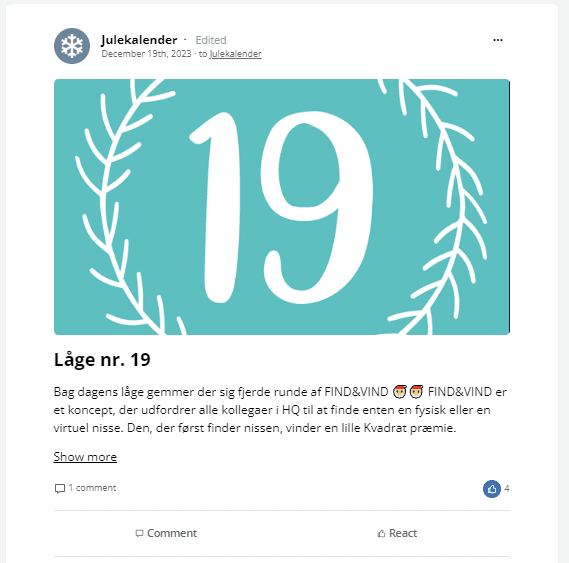
Tip: Create groups on the intranet so each employee only receives relevant content tailored to their work or interest area, such as the product group, sales team or running club.Here is an example of a post about a company event sent out to all of the company’s employees. If it had been a post about the weekly run, which only running enthusiasts are interested in hearing about, then it is smart to be able to send it out in a closed group just for runners – and thereby avoid disturbing the rest of the employees with “irrelevant” noise.
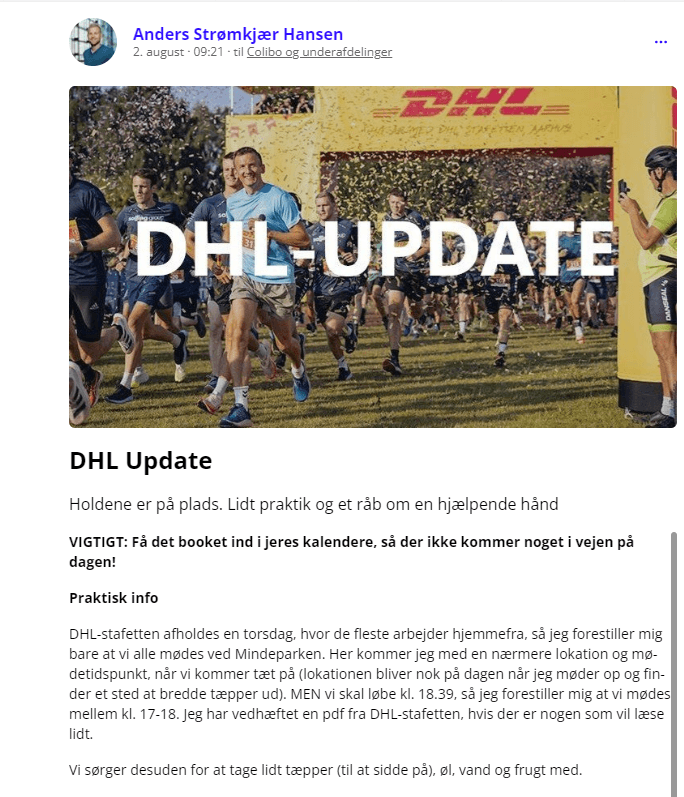
Information screens: Complement your digital hub – the intranet – with information screens and reach even more employees. With information screens, you can reach employees who otherwise do not have access to internal news via a computer or even a mobile – e.g. in production units and in the warehouse. Place the information screens in strategic areas to display important news, updates and reminders.
Tip: Use visually appealing content and change the content regularly to keep employees interested.

Team meetings and 1:1 conversations: Not everything needs to go on the intranet. Use the classic team meetings and 1:1 conversations for more personal information and when important decisions need to be made there and then.
3. Keep communication relevant
That may be easier said than done, but keep communication as relevant as possible for the recipient.
Only share what is relevant to the individual employee. Avoid unnecessary information overload and one-to-all communication.
Segment the information you send out based on employees’ roles, departments and interests.
Tip: with Colibo you can create groups that ensure the right segmentation of the content you send out
Ask employees regularly what information they find useful.
Tip: Use surveys, polls and focus groups to collect feedback.
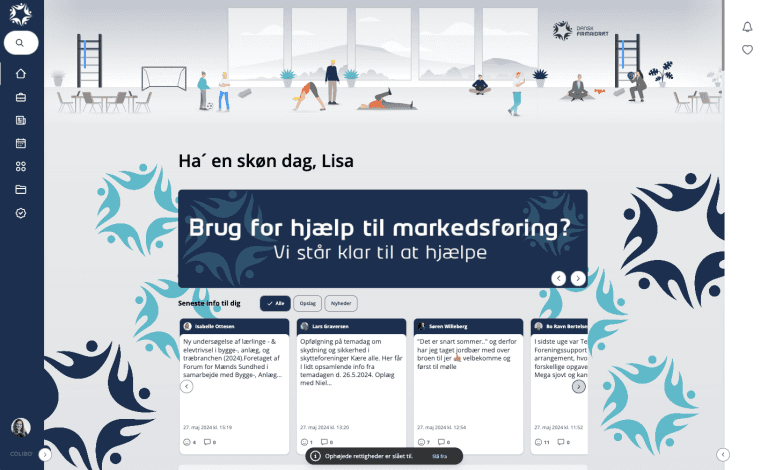
With Colibo, we can build community around different groups. Colibo brings everyone and the right people together in the right places. You are not just in one big network, you are in your own department and the groups that are relevant to you. It is about professional community and getting the content that is relevant. For example, our board now has its own exclusive area for communication and file sharing. They used email and SharePoint before, but it was nowhere near as intuitive or easy to collaborate in as Colibo. Colibo’s platform centralises everything, and that is what we lacked before.
– Lisa Skjold Slothuus, Communications Consultant, Danish Workers’ Sport Federation
4. Be more visual
A picture says more than 1,000 words – and the brain processes images much faster than words. Therefore, support your internal written communication with visual means such as images, video and infographics.
That makes it much more interesting for employees to receive your message.
5. Use a user-friendly intranet
Forget the file repository. Think of the intranet as a platform for dialogue, news and collaboration.
Make sure the intranet is easy to navigate and use. (Tip: Use a platform with an intuitive interface, clear structure and search functions. With Colibo, you get a news feed that resembles what you know from other social media. That makes it easy for employees to quickly scroll through the latest news.)
Update the intranet regularly with fresh content. (Tip: Involve employees in creating content for the intranet.)
Use the intranet’s features to promote collaboration. (Tip: Use work groups, chat functions and document management tools.)
6. Make information easily accessible
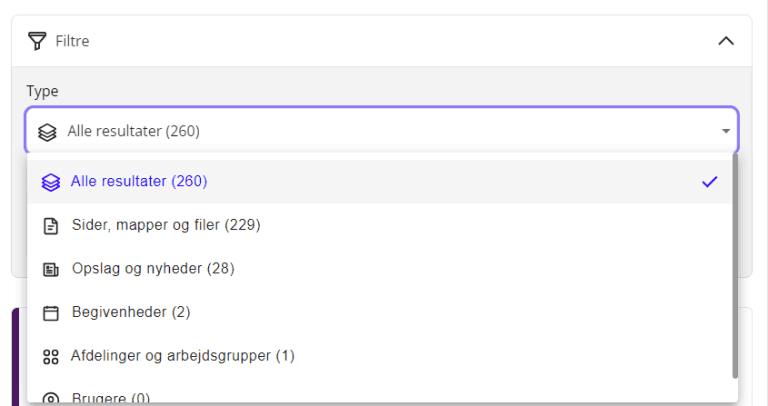
Streamline the intranet’s search function. Make sure employees can easily find the information they need.
Use relevant keywords, categories and tags.
Make it easy to filter search results.
Create an FAQ page with answers to common questions. (Tip: Make sure the FAQ page is up to date and easy to find.)
7. Use technology to your advantage
Technology should make it easier for you to communicate – not more complicated. Therefore, replace the vast sea of internal emails with an intranet platform for sharing news and creating a platform for dialogue.
Use AI to be more efficient – with search functions, chat and text generation, AI can make your day-to-day life easier. At Colibo, we are working hard to implement various AI tools that can make your day-to-day life easier.
Bonus tip:
Use humour and creativity in your communication. It can help make it more engaging and memorable.
Celebrate successes and recognise employees’ efforts. It can help strengthen morale and motivation.
Be a good role model for effective communication. Show employees how to communicate openly, honestly and respectfully.
By implementing these tips, you can create an internal communication culture that promotes collaboration, innovation and success.
Remember: Internal communication is an ongoing process. It requires continuous effort and adaptation to ensure that communication is effective and engaging for all employees.
If you have any questions or would like more information, please feel free to contact us at contact@colibo.com.